How Your Spine Works
The Nerves Inside the Spinal Canal
Spinal Cord, Cauda Equina, and Nerve Roots — What's the Difference?
There are three types of nerve structures you should know about:
1. The Spinal Cord — A Central Nerve
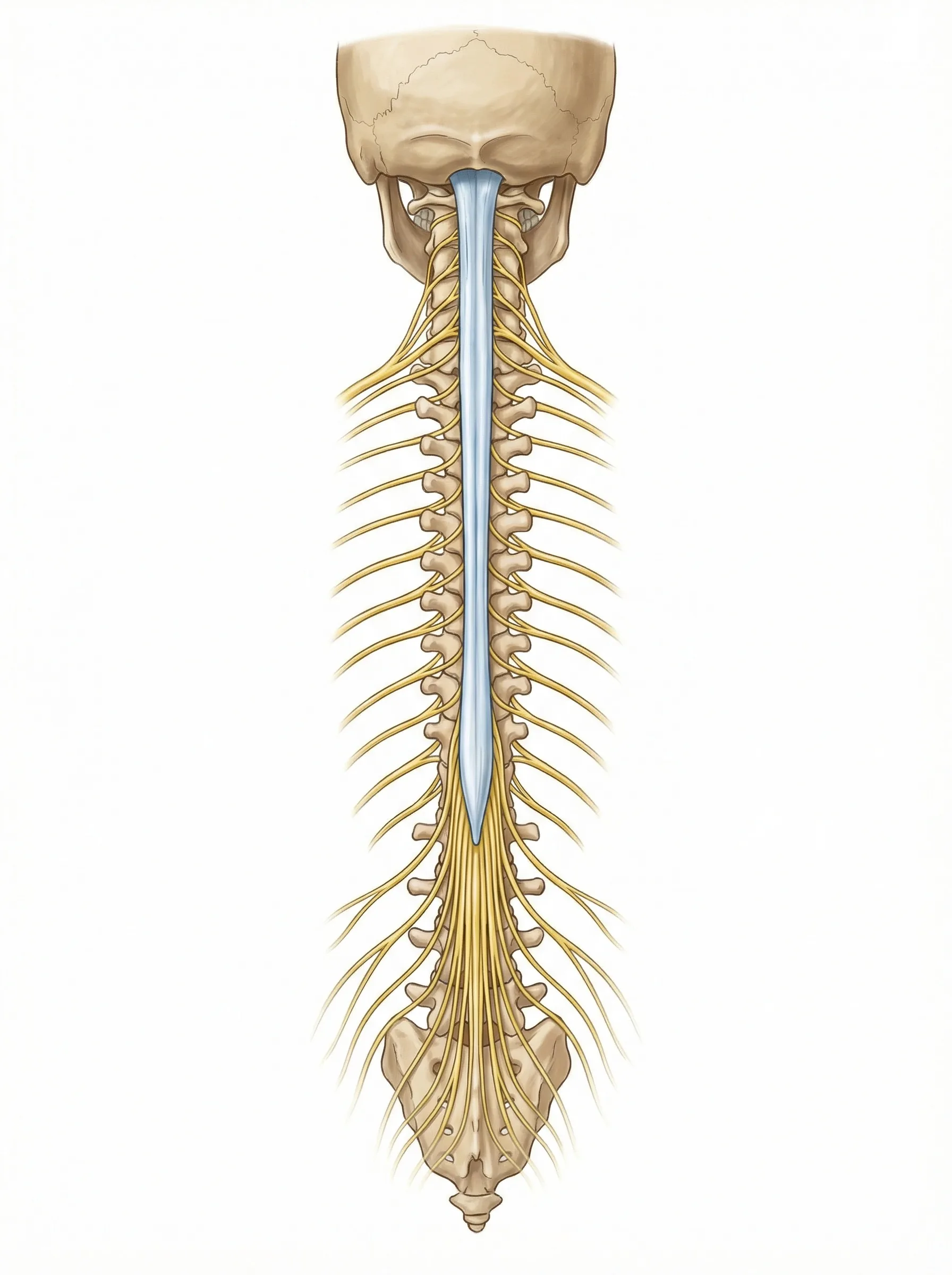
The spinal cord is a thick bundle of nerves that carries signals between your brain and your body — like a communications cable. It relays your brain's commands to your muscles and sends sensations (touch, temperature, pain) back to your brain.
The spinal cord belongs to the central nervous system and typically ends at the level of the 1st or 2nd lumbar vertebra.
Important — About Spinal Cord Injuries: Because the spinal cord is part of the central nervous system — just like the brain — damage to it is often permanent and irreversible. Much like the lasting effects of a stroke, there is currently no way to fully repair spinal cord injuries.
2. The Cauda Equina — Peripheral Nerves
Below where the spinal cord ends (below the 2nd lumbar vertebra), the spinal cord fans out into a bundle of individual nerve strands. These strands resemble a horse's tail, which is why they are called the cauda equina (Latin for "horse's tail").
The cauda equina belongs to the peripheral nervous system. This means there is a better chance of recovery compared to spinal cord injuries — though severe damage can still lead to permanent problems.
3. Nerve Roots — Peripheral Nerves
At each level of the spine, a pair of nerve roots branches off — one to the left, one to the right — and exits the spinal canal.
These nerve roots also belong to the peripheral nervous system. The nerve roots from the cervical spine control your arms and hands; those from the thoracic spine become the intercostal nerves (between your ribs); and those from the lumbar spine control your legs and feet.
Emergency Warning Signs
Because the cauda equina and nerve roots are peripheral nerves, they do have some ability to recover — unlike the spinal cord.
However, if both legs become paralyzed, this is a medical emergency.
Go to the hospital immediately if you experience:
- Sudden weakness in both legs (unable to move your ankles, unable to stand on your knees)
- Loss of sensation in both legs
- Inability to urinate or control your bladder or bowels
If these symptoms develop, permanent paralysis can result unless you receive treatment quickly.
Do not wait and see. Go to the emergency room right away.