How Your Spine Works
The Back Side of the Spine — The Posterior Elements
Facet Joints
Behind the spinal canal, there are arch-shaped bones called the laminae that form a protective roof over the nerves. On either side of the laminae are the facet joints.
These joints connect the vertebrae above and below and play an important role in guiding and supporting the movement of your spine.
How Your Spine Moves
When your spine bends, here is what happens:
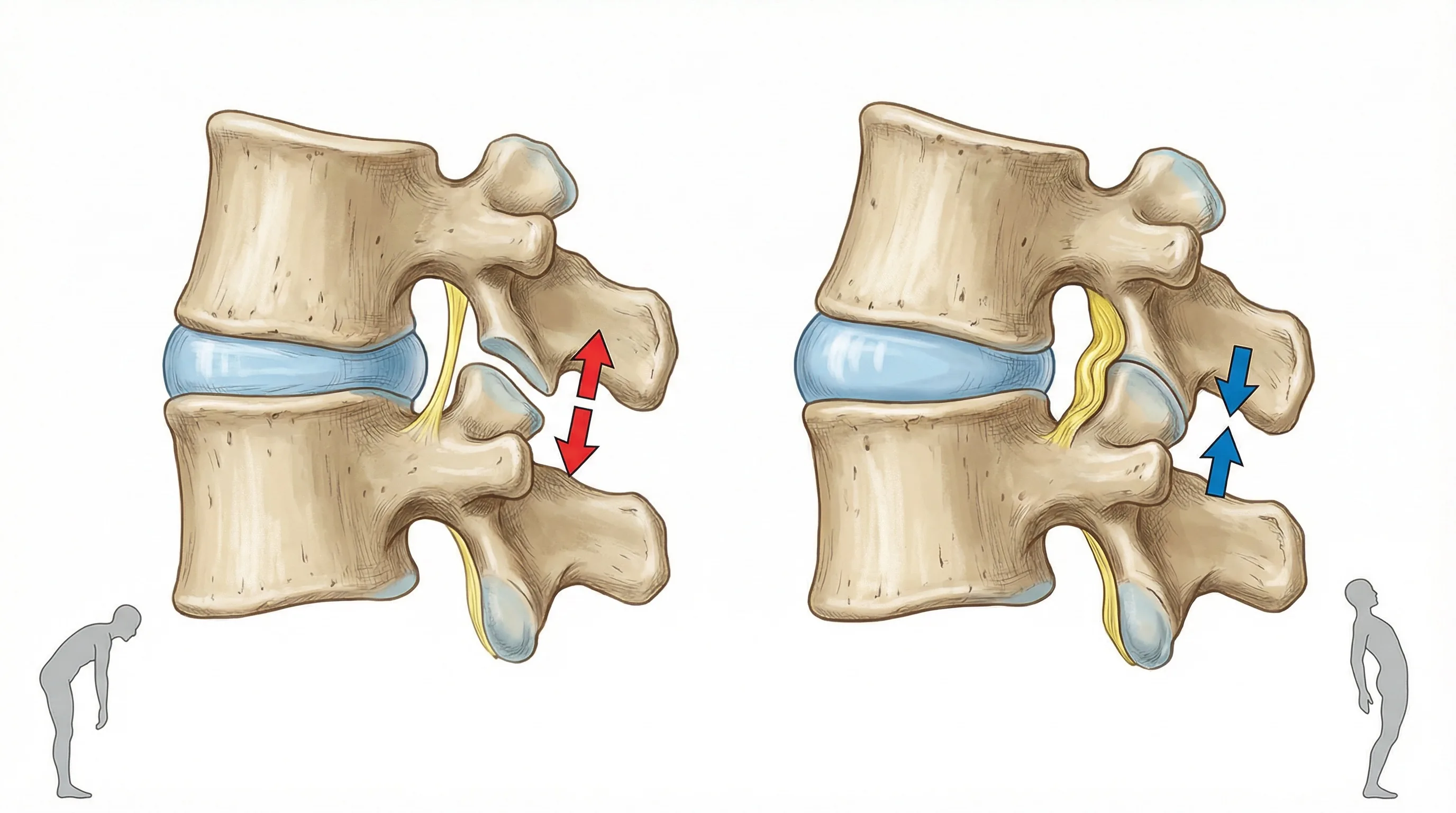
- The disc in the front acts as the pivot point
- Bending forward → the laminae and facet joints open up
- Leaning backward → the laminae and facet joints close together
Facet Joints Wear Out Over Time
Think of it this way: Facet joints have a structure similar to your knee joint.
Just as decades of bending and straightening can lead to knee arthritis, your facet joints also undergo changes after decades of repeated movement:
- Age-related wear develops
- The joints become misshapen
- The joints thicken and enlarge
This thickening is one of the reasons the spinal canal becomes narrower.
The Role of Ligaments
The vertebrae are connected to one another by strong bands of tissue called ligaments.
In spinal stenosis, two ligaments are particularly important:
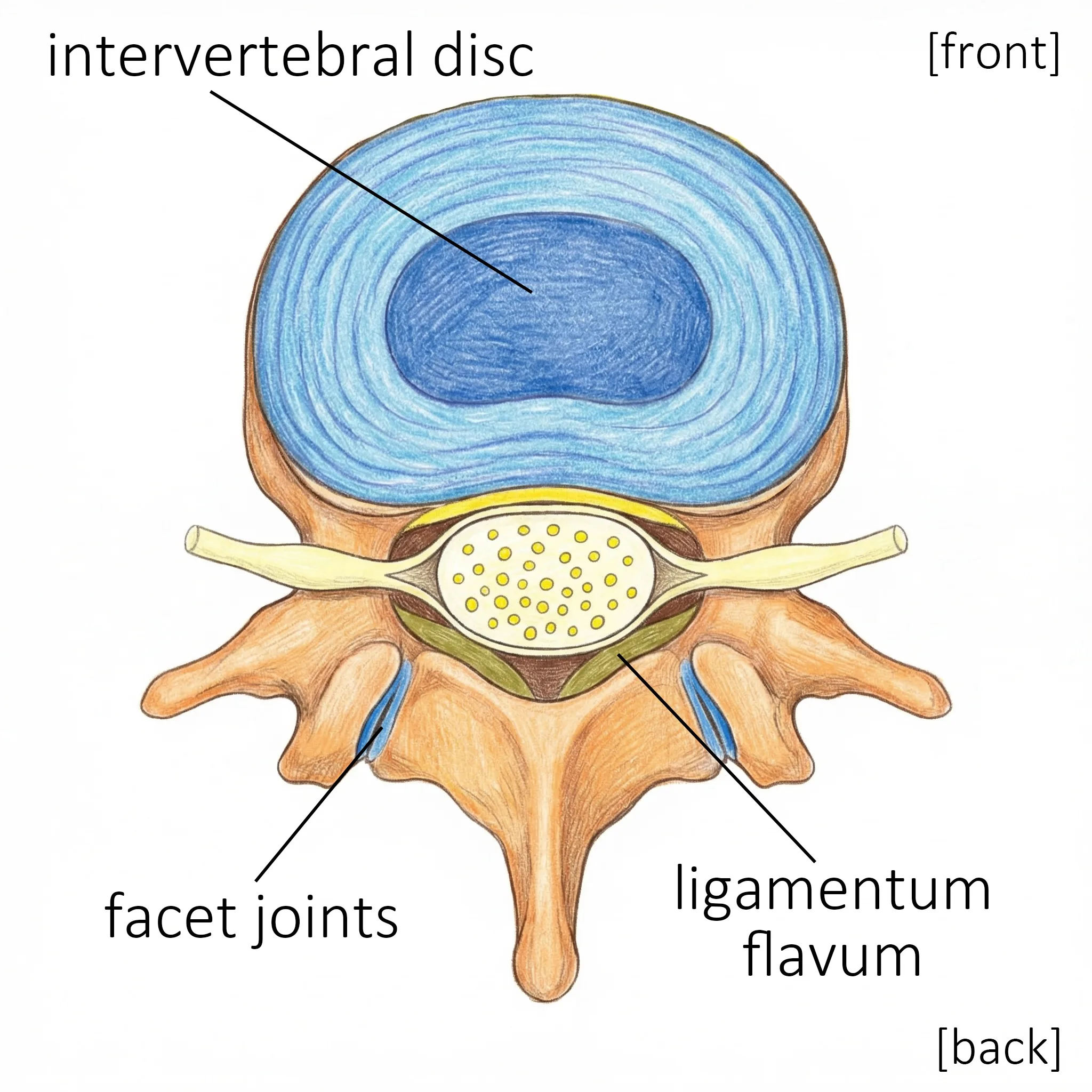
1. The Ligamentum Flavum (Yellow Ligament)
This is the single most important ligament in lumbar spinal stenosis.
The ligamentum flavum lines the back wall of the spinal canal from the inside.
2. The Interspinous Ligament
This ligament connects the spinous processes — the bony bumps you can feel along your back. Like the ligamentum flavum, it helps control how far the spine can bend forward.
How Ligaments Change Over Time
Ligaments do the following work with each movement:
When you bend forward:
- The ligamentum flavum is stretched
- It acts as a brake, limiting how far you bend
- (Imagine an elastic band being pulled taut)
When you lean backward:
- The ligamentum flavum bunches up (slackens)
- It folds in on itself
Why the Ligamentum Flavum Thickens
After decades of being stretched and released over and over:
→ The ligamentum flavum gradually thickens
→ The thickened ligament compresses the spinal canal from behind
→ This is one of the major causes of spinal stenosis
In simple terms: It's similar to what happens when you stretch and release a rubber band for years — it eventually becomes thicker and stiffer.
When the nerve compression is significant, the behavior of the ligamentum flavum during movement has a major impact on your symptoms. When you lean backward, the ligament bunches up and presses on the nerves, making leg pain worse. When you lean forward, the ligament is stretched out and pressure on the nerves is relieved. This is why leaning forward eases your symptoms while leaning backward makes them worse — a hallmark pattern of lumbar spinal stenosis, driven by the ligamentum flavum.