How Your Spine Works
Changes That Happen with Age
Spinal Aging Starts in the Discs
Here's something that may surprise you: spinal aging actually begins in your 20s.
A little-known fact: Disc degeneration starts earlier than most people expect. However, because it progresses so slowly, symptoms often don't appear until decades later.
How the Discs Change Over Time
Step 1: The Nucleus Loses Its Moisture (Starting in Your 20s)
The nucleus pulposus (the jelly-like center of the disc) gradually loses water content over the years.
→ As it dries out, the disc loses its ability to support weight effectively
Step 2: The Disc Loses Height
As the nucleus shrinks, the overall thickness of the disc decreases.
A familiar example: You may have noticed that you're a bit shorter than you were in your younger years. A major reason for this is disc degeneration. With 23 discs in your spine, even a loss of just 1–2 millimeters per disc adds up to a height reduction of 2–4 centimeters (about 1–1.5 inches).
Step 3: The Outer Ring Bulges
As the disc loses height, the remaining annulus fibrosus (the tough outer ring) has nowhere to go and begins to:
→ Bulge beyond the edges of the vertebral body
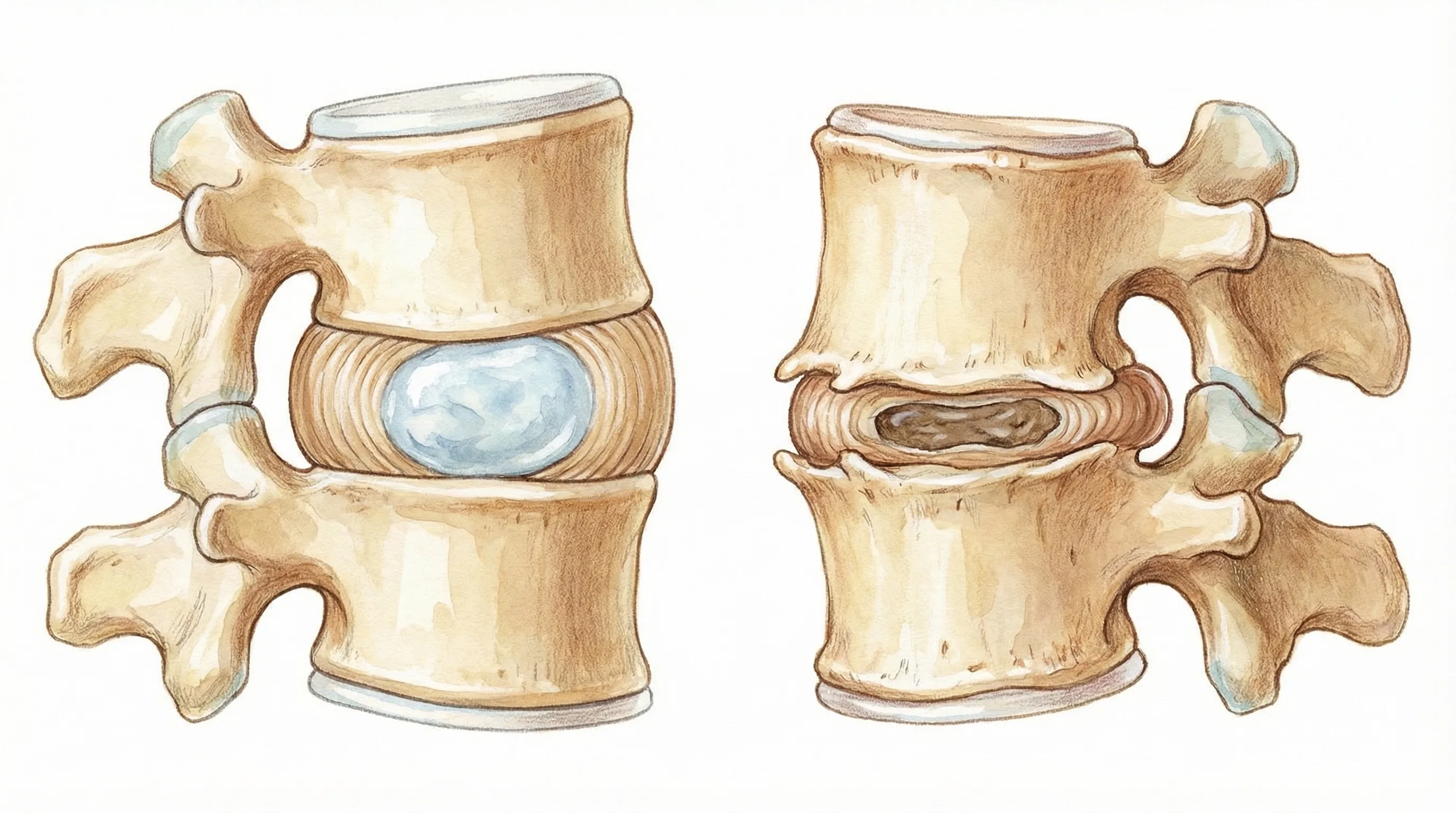
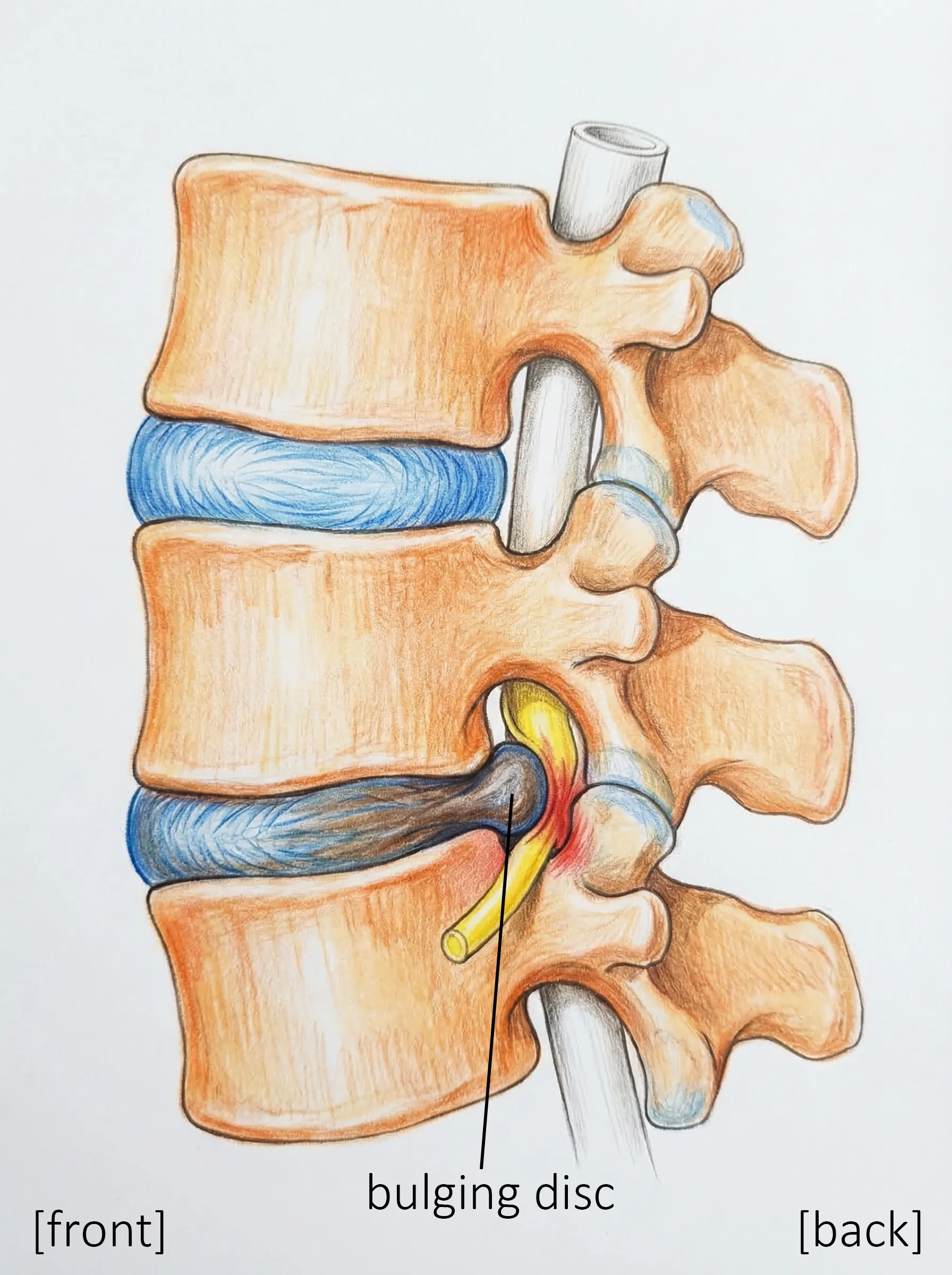
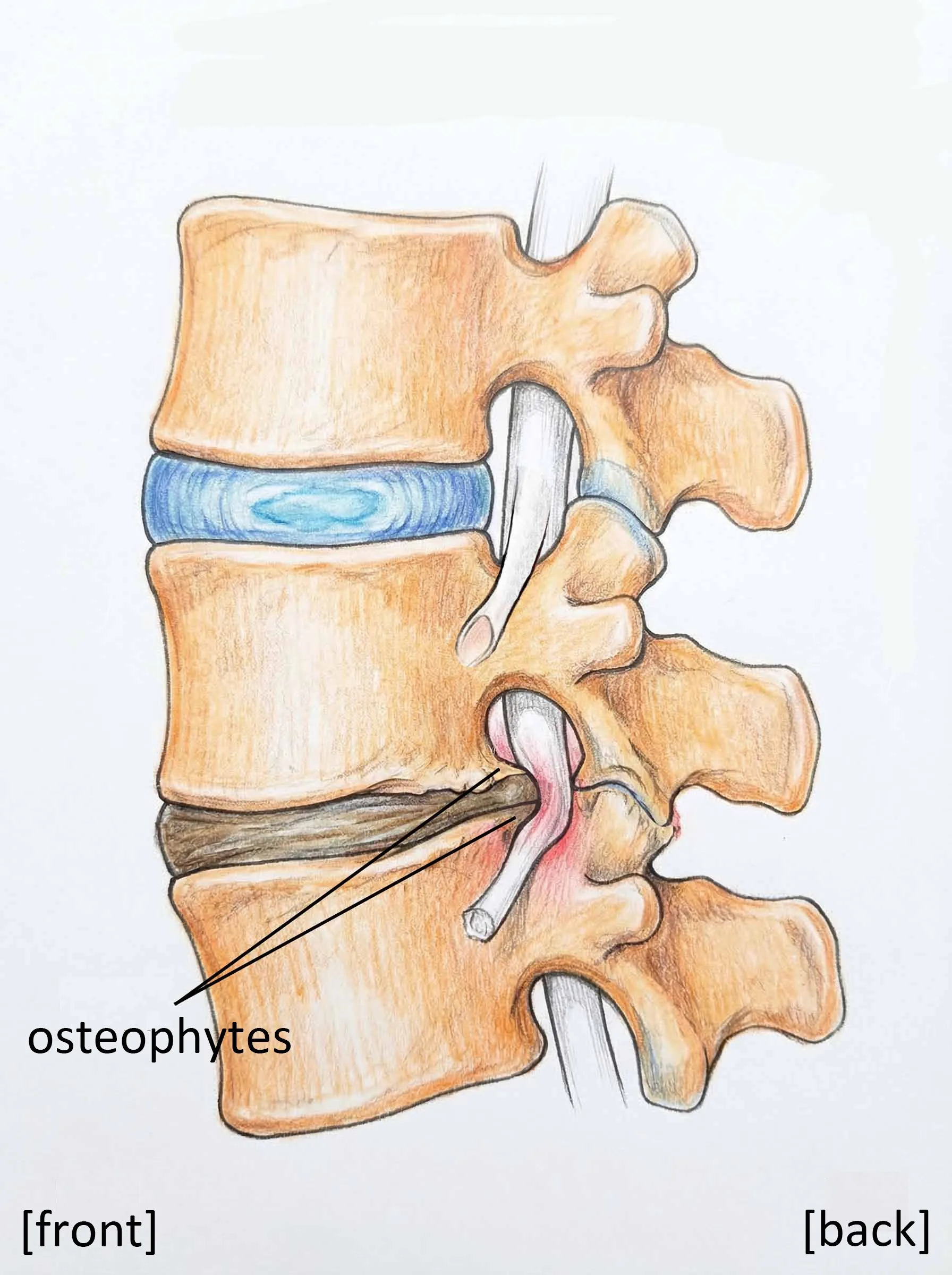
Step 4: Bone Spurs (Osteophytes) Develop
When the bulging annulus irritates the edges of the vertebral body:
→ The bone responds by growing outward
→ These bony outgrowths are called osteophytes (bone spurs)
Osteophytes can contribute to nerve compression.
Which Parts of the Spine Are Most Affected?
| Region | Range of Motion | Age-Related Changes |
|---|---|---|
| Cervical (neck) | Moves a great deal | Prone to degeneration |
| Thoracic (mid-back) | Limited movement (attached to ribs) | Less affected |
| Lumbar (lower back) | Bears heavy loads and moves a great deal | Most affected |
The general rule: the more a section of the spine moves, the more susceptible it is to age-related wear.
That is why problems most commonly occur in the cervical spine (neck) and the lumbar spine (lower back).
Why the Spinal Canal Narrows — Putting It All Together
Over time, several changes happen simultaneously:
| Structure | When Young | With Aging |
|---|---|---|
| Discs | Plump and springy | Dried out and thinner |
| Bone (vertebral body) | Smooth edges | Osteophytes (bone spurs) form |
| Facet joints | Smooth and gliding | Misshapen and thickened |
| Ligaments (ligamentum flavum) | Thin and flexible | Thickened and stiff |
| Spinal canal | Spacious | Narrowed ← This is "stenosis" |
When all of these changes accumulate, the spinal canal becomes too narrow, and the nerves inside are compressed.
This is lumbar spinal stenosis. Incidentally, when the same degenerative process occurs in the cervical spine, it compresses the spinal cord in the neck and leads to a condition called cervical spondylotic myelopathy.