Conditions That Look Similar
Degenerative Spondylolisthesis
What Is Spondylolisthesis?
Spondylolisthesis means that one vertebra has slipped forward or backward relative to the one below it.
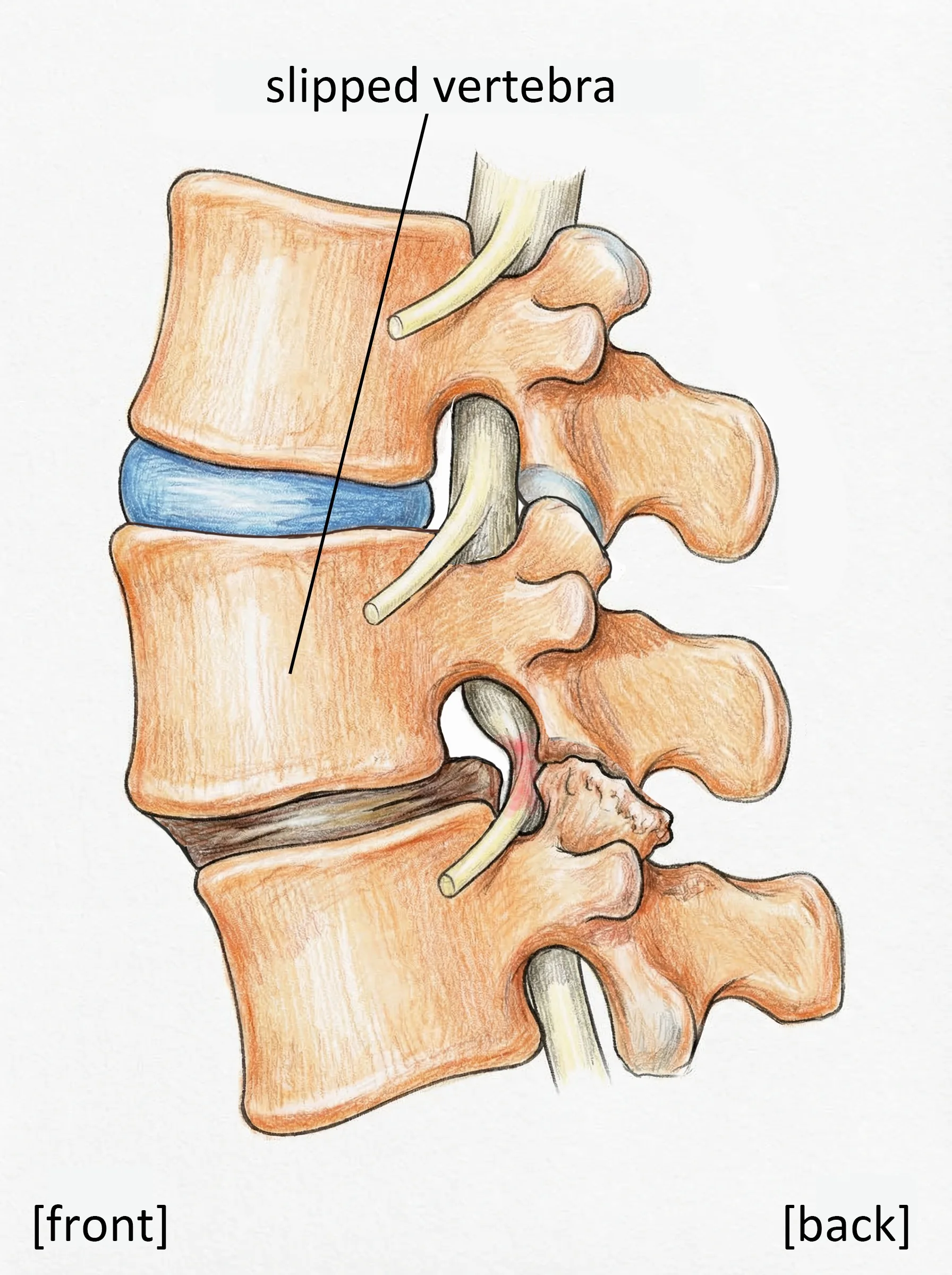
How It Relates to Spinal Stenosis
When a vertebra slips, the spinal canal is more likely to become narrow. Think of it this way: if one building block in a stack shifts out of place, the tunnel running through the middle shifts too, and the nerves inside get squeezed.
This means spondylolisthesis and spinal stenosis are not separate conditions -- they are often related.
| Diagnosis | What It Means |
|---|---|
| Lumbar spinal stenosis | The spinal canal is narrow |
| Degenerative spondylolisthesis | A vertebra has slipped out of place |
| Stenosis with degenerative spondylolisthesis | Both are present |
If your doctor tells you that "you also have spondylolisthesis," the slip may be one of the reasons your spinal canal has become narrow.
How It Affects Treatment
The degree and instability of the slip can influence the treatment plan. Instability is assessed by taking X-rays while you bend forward and lean backward, then measuring how much the slip changes with movement. If the vertebra shifts significantly forward when you bend, that indicates high instability.
- Mild slip -> Decompression surgery alone may be sufficient
- Unstable slip -> A fusion procedure (surgically stabilizing the spine) may be necessary
When instability is high, performing decompression alone (removing bone and ligament to make more room) may not be enough, because the vertebra can slip further and re-narrow the canal. That is why fusion is often recommended in these cases.