Understanding Your Pain
Why Walking Makes It Worse -- Intermittent Claudication
What Is Intermittent Claudication?
The most characteristic symptom of spinal stenosis is intermittent claudication.
Intermittent claudication means: While walking, your legs become painful or numb, forcing you to stop. After resting for a short time -- especially if you lean forward -- the symptoms ease and you can walk again.
This cycle repeats over and over.
Why Does This Happen?
When you stand and walk, your lower back naturally arches backward.
When your back arches, the ligamentum flavum buckles inward, making the spinal canal even narrower.
This increases pressure on the nerves, triggering your symptoms.
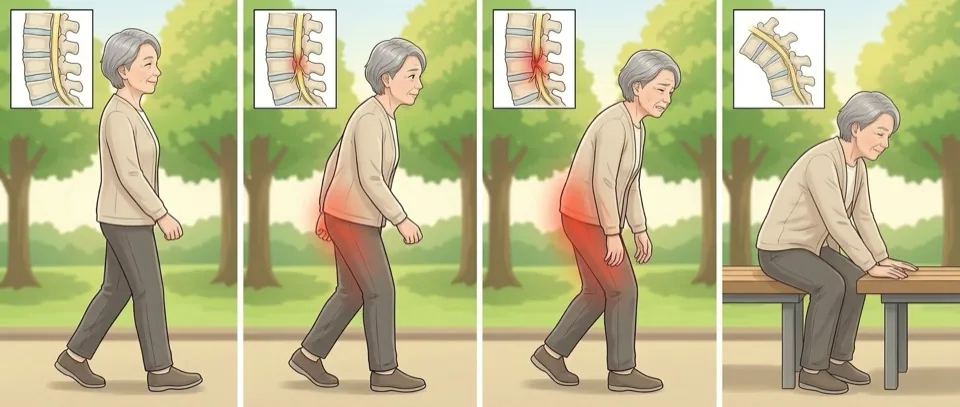 When the body extends, the nerves are compressed and sciatica appears. When leaning forward, the compression is relieved and the pain subsides.
Why Leaning Forward Helps
When you lean forward, your lower back rounds.
When your back rounds, the ligamentum flavum is stretched thin, and the spinal canal opens up.
This reduces pressure on the nerves, and you feel better.
That is why:
- Pushing a shopping cart feels comfortable
- You can ride a bicycle without trouble
- Sitting in a chair brings relief
All of these positions involve leaning forward, which widens the spinal canal.