Understanding Your Pain
What Is Chronic Pain?
When Pain Persists...
Normally, pain serves as a "warning signal." Once the problem is resolved, the pain should go away.
However, when pain lasts longer than three months, it can develop into a condition called chronic pain. Studies show that roughly 15% of the general population lives with chronic pain, and among those aged 75 and older, this rises to about 37%. Chronic pain becomes more common with age.
From Acute Pain to Chronic Pain -- How the Nervous System Changes
In chronic pain, the nervous system itself undergoes gradual changes.
An important point: Chronic pain is not "imaginary" and it is not about "not being tough enough." The nervous system itself has physically changed. That is why it is so important to treat pain properly at an early stage. Some people refuse painkillers because they worry the medication will stop working when they "really need it," or because of concerns about side effects. While it is fortunate if pain resolves on its own, in conditions like lumbar spinal stenosis where pain persists, enduring the pain can allow nerve sensitization to progress until it becomes truly unbearable. Worse still, once chronic pain is established, it becomes much harder to treat.
Your Body Has a Built-In Pain Control System
Your body actually has a built-in mechanism for suppressing pain.
The brainstem sends chemical messengers -- serotonin and norepinephrine -- down to the spinal cord, where they act as a brake on pain signals.
However, when chronic pain persists, this braking system can weaken or even start amplifying pain instead.
How this relates to your medications: Drugs like duloxetine (Cymbalta), tramadol, and neurotropin work by strengthening this "natural braking system." Because they work through a different mechanism than ordinary painkillers, they can be effective for pain that does not respond to standard pain medications.
The Vicious Cycle of Pain
Chronic pain is known to trap people in a vicious cycle.
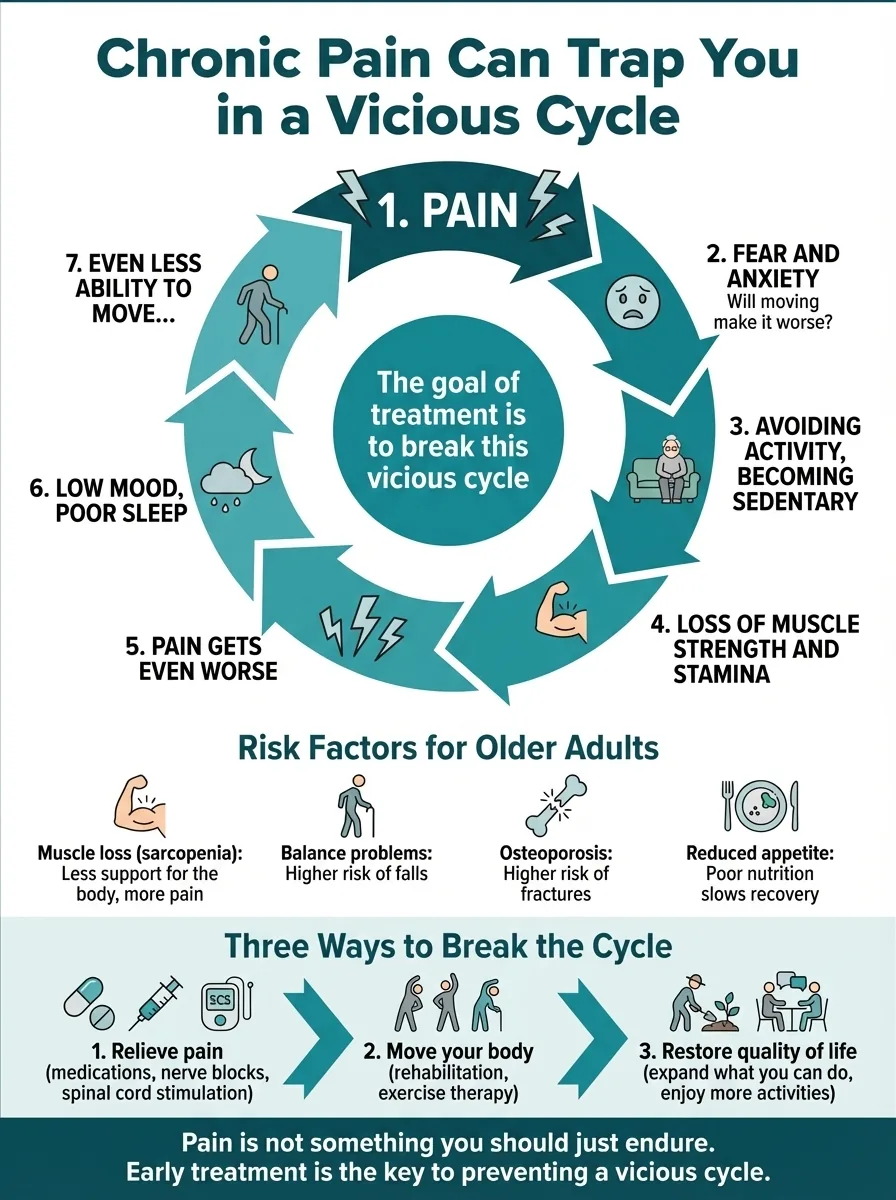
For older adults in particular, age-related changes compound this cycle.
| Contributing Factor | Impact |
|---|---|
| Muscle loss (sarcopenia) | Less support for your body, more pain |
| Balance problems | Higher risk of falls |
| Osteoporosis | Higher risk of fractures |
| Reduced appetite | Poor nutrition slows recovery |
The goal of treatment: The goal is to break this vicious cycle.
- Relieve your pain (medications, nerve blocks, spinal cord stimulation, etc.)
- Improve your daily function (rehabilitation, exercise therapy)
- Restore your quality of life (expand the things you can do)
Common Misconceptions About Pain
Are any of these incorrect beliefs influencing how you think about your pain?
| Common Misconception | The Reality |
|---|---|
| "Something must be damaged for there to be pain" | Pain can occur even without tissue damage |
| "The abnormalities on my X-ray or MRI are causing my pain" | Imaging findings and pain often do not match |
| "Moving is dangerous -- rest is best" | Appropriate activity actually helps recovery |
| "If I can tolerate the pain, I should just leave it alone" | Even mild pain can become chronic if left untreated |
| "Painkillers are bad for your body" | Used properly, they are an essential tool for preventing the pain cycle |
Think of it this way -- painkillers are like a fire extinguisher: A fire extinguisher can put out a small fire, but once the blaze is out of control, a fire extinguisher is not enough. Pain works the same way -- catching it early is the key. When you feel pain, it is most effective to take your painkiller within 30 minutes rather than trying to tough it out.