"I'm Afraid I Won't Be Able to Walk Anymore" — You're Not Alone
An estimated 103 million people worldwide live with lumbar spinal stenosis. This is one of the most common spinal conditions — and yet, so many suffer in silence.
About This Column
Hello. My name is Dr. Hiroyuki Katoh, and I'm an orthopedic spine surgeon.
I treat patients with conditions affecting the lower back and spine. In my clinic, I hear the same words from so many patients:
"When I'm walking, my legs start to hurt, and I have to stop."
"I'm fine when I'm pushing a shopping cart, but walking without one is miserable."
"My walks keep getting shorter and shorter..."
If any of this sounds familiar — it may be a sign of lumbar spinal stenosis (LSS), a condition where the spinal canal in your lower back narrows and presses on the nerves.
In this weekly column series, I'll walk you through this condition one step at a time. From how the disease works, to treatment options, to deciding whether surgery is right for you. My goal is to help you replace fear with understanding.

A Condition Shared by Millions
Lumbar spinal stenosis affects roughly 1 in 10 people over the age of 50. In Japan alone, an estimated 5.8 million people have this condition. Globally, the numbers are even more striking — studies suggest that up to 103 million people are affected worldwide, making it one of the leading causes of disability in older adults.
In other words, you almost certainly know someone — a neighbor, a friend, a family member — who is dealing with the same thing.
This condition develops when the "tunnel" inside your spine (the spinal canal) gradually narrows with age, putting pressure on the nerves that run through it. We'll explore exactly how this happens in next week's column, but here's what I want you to know right now:
This is not your fault.
It's a natural change that happens in a spine that has supported you faithfully for decades. You don't need to blame yourself for bad posture or not exercising enough.
Does This Sound Like You?
The most characteristic symptom of lumbar spinal stenosis is something called intermittent claudication — a pattern that goes like this:
- You're walking, and gradually your legs begin to ache, feel heavy, or go numb
- You stop and rest — sitting down or leaning forward — and the pain eases
- You start walking again, and after a while, the pain returns
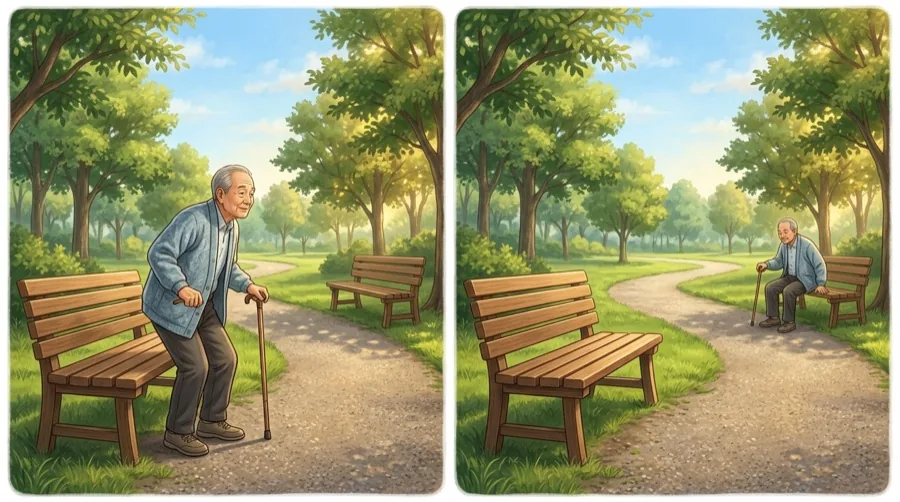 Intermittent claudication: pain comes on with walking and eases with sitting or bending forward
"I used to walk for 30 minutes without stopping. Now I can barely manage 10." — Does that sound like your experience?
Here's something interesting: many people with this condition find that riding a bicycle feels perfectly fine, or that they can walk comfortably while pushing a shopping cart. That's because leaning forward slightly opens up the spinal canal, relieving the pressure on the nerves.
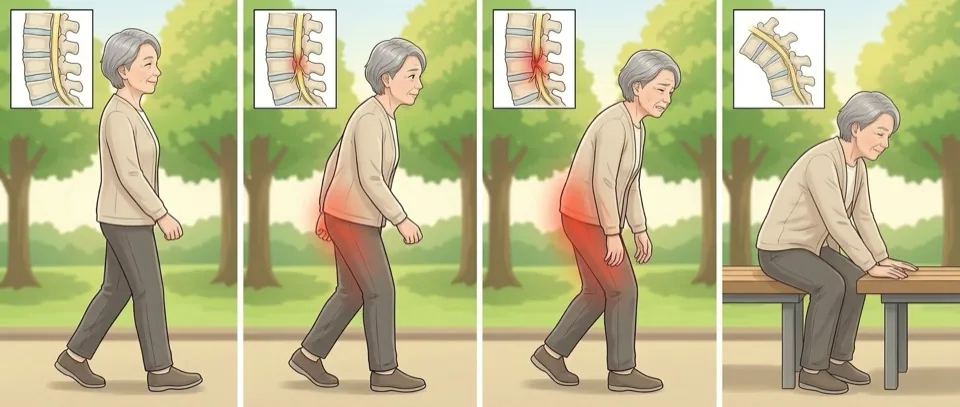 When you stand upright, the nerves are compressed, causing sciatica-like pain. When you lean forward, the pressure is relieved and the pain subsides.
"Toughing It Out" Is Not the Answer
When I talk with patients in my clinic, so many of them say things like:
"I can still walk, so I'm fine."
"It's just old age — nothing to be done about it."
"I don't want to worry my family, so I keep it to myself."
I understand those feelings deeply. But as a doctor, I have to be honest with you — enduring pain and numbness in silence is not always the right thing to do.
Here's why: when nerves are compressed for a long time, they can become harder to heal.
"Being able to tolerate the pain" is not the same as "the condition isn't getting worse."
I'm not saying you need surgery right away, or that something terrible is about to happen. What I am saying is this: understanding your condition is the single best way to ease your anxiety.
Let's Learn Together Over the Coming Weeks
This column series spans 24 weeks, organized into four stages that will guide you from understanding to action:
| Stage | Theme | What You'll Learn |
|---|---|---|
| Learn | Understanding the condition | How spinal stenosis works, symptoms, diagnosis, conservative treatment |
| Face It | Considering treatment | Addressing fears about surgery, when to consider it, types of procedures |
| Decide | Surgery and recovery | Preparing for surgery, what to expect, rehabilitation, returning to daily life |
| Beyond | Looking ahead | Preventing recurrence, options when pain persists, guidance for family members |
Each week's column takes about 5 to 7 minutes to read.
You don't have to face this alone. Let's take this journey together — one week at a time. You are not alone.