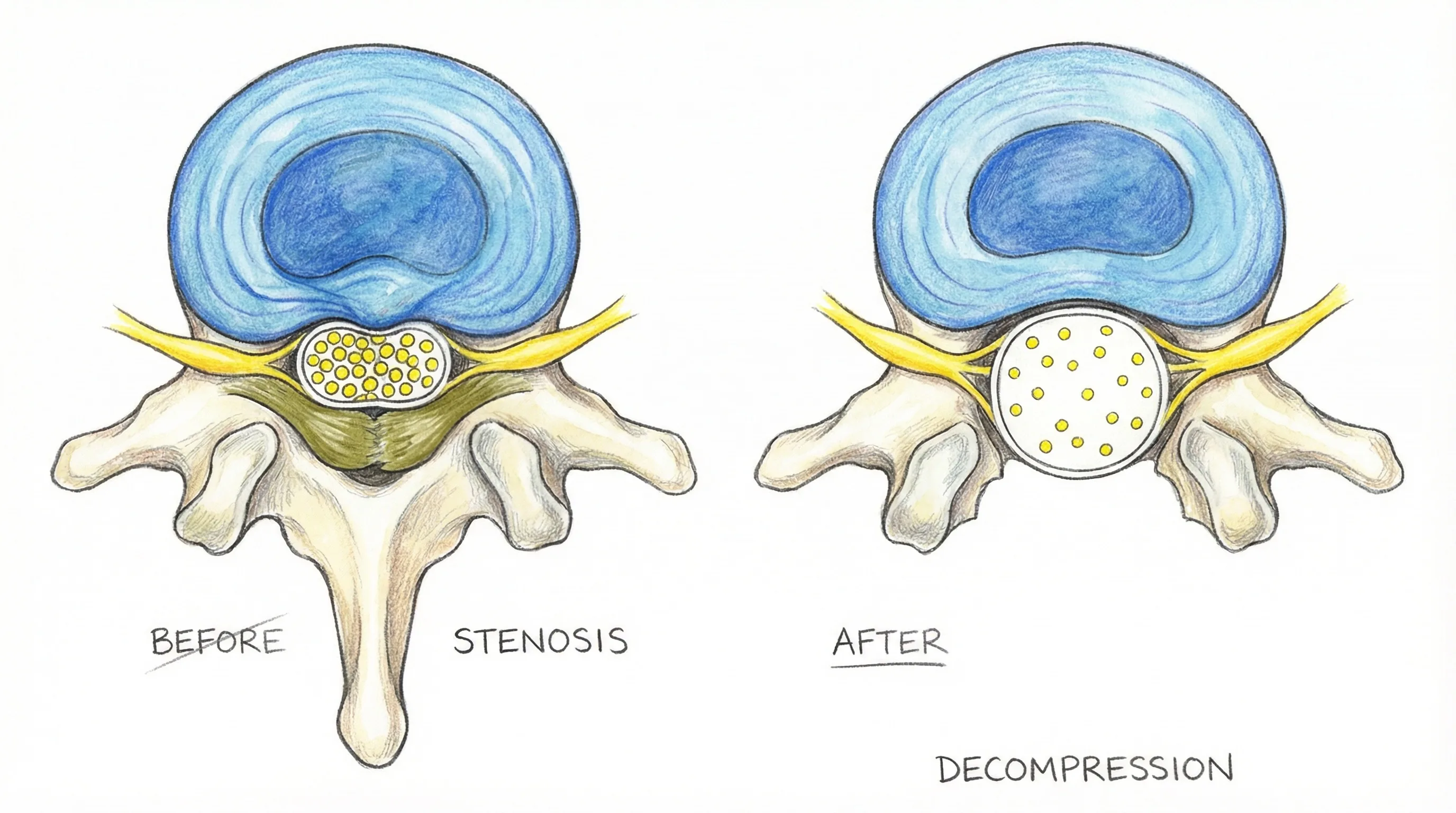
Laminectomy, laminoplasty, and endoscopic surgery — how each procedure works to relieve nerve compression.
This surgery widens the pathway for your nerves and relieves the pressure that causes your symptoms.
What You'll Learn
What decompression surgery does
What the clinical guidelines recommend (evidence)
When to consider surgery
Types of decompression (laminectomy, laminoplasty, endoscopic)
What happens on the day of surgery
Expected results and outcomes
Risks and complications
Recovery and rehabilitation
Frequently asked questions
1. What Decompression Surgery Is and When to Consider It
What Is Decompression Surgery?
Picture a tunnel whose ceiling has partly caved in, so that it is too narrow for traffic. Decompression surgery is like shaving away the collapsed ceiling to widen the tunnel again.
At the back of each vertebra, there is a bony "lid" called the lamina
In decompression surgery, your surgeon removes part of this bony lid and any thickened ligaments to widen the spinal canal (the passageway where your nerves travel)
If several levels are narrowed, the same procedure is performed at each affected level
The goal is only to relieve pressure on the nerves. This surgery does not straighten a curved spine or correct its alignment.
What the Guidelines Recommend (Clinical Practice Guidelines 2021)
The Japanese Clinical Practice Guidelines for Lumbar Spinal Stenosis (2021, 2nd edition) recommend the following for decompression:
Recommendation
Grade
Evidence Level
Decompression surgery has been shown to produce favorable outcomes in multiple studies. For LSS without instability where conservative treatment has not been effective, decompression surgery is recommended.
2 (Suggested)
B
Key points from the guidelines:
Conservative treatment is recommended as the initial approach, but prolonged conservative treatment should be avoided in severe cases (including from a cost-effectiveness standpoint)
For LSS without instability or deformity, outcomes at 2 years favor surgery over conservative treatment
The difference between surgery and conservative treatment narrows after 2 years over time
The possibility of surgical complications must be explained to patients before surgery
What this means for you:
The guidelines show that surgery is effective when performed on the right patient at the right time, although it is not a cure-all. Points to remember:
Decompression works best when there is no instability (no slippage or excessive movement)
Surgery should be considered after conservative treatment has been given a fair trial
In severe cases, though, you should not continue ineffective conservative treatment indefinitely
When to Consider Surgery
Situations Where Surgery May Be Recommended
Situation
Explanation
Conservative treatment hasn't helped
No improvement after 3–6 months of non-surgical treatment
Daily life is significantly affected
Unable to walk or work
Worsening nerve symptoms
Leg weakness or loss of sensation
Bladder or bowel problems
May require emergency surgery
When It's Urgent
The following symptoms may require immediate surgical evaluation:
Signs of Cauda Equina Syndrome
Difficulty urinating or having bowel movements, or loss of control
Numbness in the groin or genital area
Sudden weakness in both legs
These are signs that your nerves are severely compromised. Without prompt treatment, recovery may be more difficult.
2. Types of Surgery and the Day of the Operation
Types of Decompression Surgery
Laminectomy
The lamina (the bony arch at the back of the vertebra) is removed to widen the nerve pathway. This is the most traditional and widely used form of decompression.
Laminoplasty
Instead of completely removing the lamina, the surgeon reshapes and expands it while preserving the bone. By keeping the bony structure as intact as possible, this approach helps maintain spinal stability after surgery.
Partial Laminectomy (Laminotomy)
Only a small portion of the lamina is removed. This is chosen when the area of compression is limited.
Procedure
What It Does
Key Feature
Laminectomy
Removes the lamina
Most established; allows wide decompression
Laminoplasty
Expands the lamina while preserving bone
Maintains bony structure
Partial laminectomy
Removes only a small part of the lamina
Least invasive
Endoscopic and Minimally Invasive Surgery
What Is Endoscopic Surgery?
Instead of making a large opening, the surgeon passes a thin camera (endoscope) and specialized instruments through a small incision, and operates while watching the inside of your body on a screen.
Types of Minimally Invasive Surgery
Procedure
Incision Size
Key Feature
Endoscopic surgery
1–2 cm
Uses an endoscope camera
Microscopic surgery
3–5 cm
Uses a surgical microscope for precision
Benefits for Older Patients
Endoscopic surgery has particular advantages for older patients.
Smaller incision = Less pain
Because the skin and muscles are not cut extensively, post-surgical wound pain tends to be milder. This often means less need for pain medication and better sleep.
Less blood loss
The smaller surgical field usually means less bleeding. This helps patients with heart or kidney conditions, because it puts less strain on the circulation.
Getting back on your feet sooner
Because muscle damage is minimized, many patients can stand and walk within a day or two after surgery. This matters most for older patients, because long bed rest can lead to muscle loss, pneumonia, and cognitive decline.
Shorter hospital stay
Faster recovery from the smaller incision often means a shorter time in the hospital, which lowers the burden on you and your family and lowers costs.
Important Considerations
Not every patient or condition is suitable for endoscopic surgery (severe spinal deformity or significant obesity may make traditional surgery the safer option)
The surgeon's experience matters greatly. With less experienced surgeons, complications may increase and the operation may take longer
Even though the incision is smaller, the work being done inside the body is essentially the same, so anesthesia and complication risks are never zero
A smaller incision reduces the overall burden on your body, but it is still not an "easy" surgery. It is surgery designed to minimize impact on your body.
What Happens on the Day of Surgery
Before Surgery
Step
What Happens
1
Outpatient consultation and testing
2
Surgical explanation and consent
3
Hospital admission (1–2 days before surgery)
4
Pre-surgical tests (blood tests, ECG, etc.)
5
Preparation the day before surgery
The Day of Surgery
Procedures vary slightly between hospitals.
1. Anesthesia
You will be under general anesthesia, so you will be asleep throughout the surgery and will not feel any pain.
2. Positioning
You will be positioned face-down on the operating table.
3. Making the Incision
A skin incision of several centimeters to about 10 centimeters is made along the center of your lower back (the length depends on how many levels need to be treated).
4. Removing Bone and Ligament
The muscles are gently separated to expose the vertebral arch (lamina) and ligaments
Using specialized instruments, the surgeon carefully removes the portions of bone and ligament that are compressing your nerves
If necessary, herniated disc material is also removed
5. Checking That the Nerves Are Free
The surgeon visually confirms that the tunnel has been widened enough for the nerves to move freely.
6. Closing the Wound
Bleeding is controlled, and the incision is sutured closed. The surgery is complete.
Typical Surgery Time and Hospital Stay
These are general estimates. Your actual experience may vary depending on your age, other health conditions, and your hospital's protocols.
Item
Estimate
Surgery time
About 1–2 hours per level
Hospital stay
A few days to 2 weeks
3. Results, Outcomes, and Risks
Expected Results
The primary goals of decompression surgery are to reduce leg pain and numbness and to increase the distance you can walk.
For most patients:
Leg pain and numbness improve compared to before surgery
The distance you can walk without stopping increases
If your nerves have been compressed severely for a long time, some numbness or weakness may remain. Before surgery, be aware that your legs may not return to exactly how they felt when you were younger.
Outcomes — Surgery vs. Conservative Treatment
Multiple large-scale studies have compared the long-term results of decompression surgery with conservative treatment.
Time Period
Surgery vs. Conservative
What This Means
Up to 2 years
Surgery is superior
Greater improvement in pain, physical function, and quality of life
2–4 years
Surgery maintains its advantage
Though the gap begins to narrow
4–8 years
The gap narrows further
Some outcome measures lose statistical significance
8–10 years
Surgery still better for leg pain and function
But differences in back pain and satisfaction fade
Key Studies
SPORT Study (RCT: 289 patients + Observational cohort: 365 patients):
This is the largest study conducted in the United States. When analyzed based on the treatment patients actually received, the surgical group was superior in all outcome measures from 6 weeks through 2 years. The surgical advantage persisted at 4 years, but results gradually declined between 4 and 8 years.
Note that 43% of patients assigned to conservative treatment had crossed over to surgery by 2 years, and 52% by 8 years, so the conservative group's results include surgical outcomes.
Maine Lumbar Spine Study (8–10 year outcomes):
At 8–10 years, leg pain and back function remained better in the surgical group, but back pain and treatment satisfaction no longer showed a significant difference. The reoperation rate at 10 years was 23%.
What This Means for You
The benefit of surgery over conservative treatment tends to narrow over time, but this does not mean that surgery "stops working." Many patients in the conservative group eventually had surgery anyway (43% by 2 years, 52% by 8 years), which suggests that for patients with severe symptoms, earlier surgery may be the better choice.
The Importance of Stability
If your spine is unstable, decompression alone may not be enough.
The guidelines confirm that decompression is effective for LSS without significant slippage or instability. When deformity or instability is present, decompression results tend to be less favorable.
If instability is identified, fusion surgery may be added to your treatment plan.
Risks and Complications
Every Surgery Carries Some Risk
Your surgical team will take every precaution to keep you safe, but no surgery is completely free of risk.
Main Risks
Risk
Frequency
Explanation
Infection (SSI)
1–3%
Wound or deep infection; may require additional surgery
Dural tear
About 9%
The membrane surrounding the spinal cord may be damaged, causing spinal fluid leakage
Nerve injury
Less than 1%
Worsening numbness or weakness in the legs
Bleeding or hematoma
Rare
A blood clot may form and compress nerves again
Bladder or bowel problems
Rare
Temporary or lasting dysfunction due to nerve damage
Deep vein thrombosis
Rare
Blood clots forming in the leg veins
Reoperation
8–23%
8% at 2 years, 23% at 10 years
Long-term consideration:
If a significant amount of bone is removed, the spine may become unstable over time, causing pain. In such cases, a secondary fusion surgery may be needed.
Guideline data on complications:
Studies cited in the guidelines report an overall complication rate of 10–24%, though definitions and follow-up periods vary widely. A systematic review of 9 randomized controlled trials including 1,658 patients found no significant difference in complication rates between surgical and conservative treatment groups.
How to Reduce Your Risk
Quit smoking: smoking increases infection risk
Manage blood sugar, especially if you have diabetes
Eat well: good health before surgery helps recovery
Rehabilitate early: getting up and moving soon after surgery helps
If you have other medical conditions (heart disease, diabetes, dialysis, etc.), discuss your individual risks with your doctor.
A Note for Patients with Obesity
From the guideline commentary:
For patients with a BMI of 30 or higher, decompression surgery can still be effective, but the rate of symptom improvement tends to be lower compared to non-obese patients. Back pain is also more likely to persist significantly after decompression alone.
4. Recovery, Cost, and Common Questions
Recovery and Rehabilitation
Day of Surgery Through the Next Day
On the day of surgery, you will typically rest in bed. By the next day or the day after, you will begin standing and walking with a brace (corset).
About 1 Week
Most patients can walk to the bathroom and around the ward on their own. Wound pain gradually decreases.
After Discharge Through About 1 Month
You will continue wearing your brace and doing light exercise such as walking. Avoid heavy lifting and staying in one position for long periods.
Beyond That
Under the guidance of your doctor and rehabilitation therapist:
Gentle exercises to strengthen your back and abdominal muscles
Practice maintaining proper posture and getting up correctly
The goal is to learn how to use your body in ways that reduce the risk of recurrence.
Recovery Timeline
Time After Surgery
What to Expect
1 week
Begin walking, practice daily activities
2–4 weeks
Discharge from hospital, resume home life
1–3 months
Light work and household tasks become possible
3–6 months
Most activities become possible
6 months–1 year
Full recovery
The Cost Perspective
From the guideline commentary:
A study comparing 170 surgical patients with 264 conservative treatment patients found that the average cost was actually higher in the conservative treatment group. The reasons:
A significant proportion required multiple epidural injections
72.4% of conservative treatment patients eventually crossed over to surgery
While a single successful injection was the most cost-effective approach, patients who required multiple injections ended up costing more than a properly performed decompression surgery. So continuing ineffective conservative treatment indefinitely is a burden for patients and is not cost-effective either.
Frequently Asked Questions
Q. Am I too old for surgery?
A. Age alone does not determine whether surgery is safe for you. Your blood pressure, heart, lung, and kidney function are carefully evaluated. The decision weighs the "risk of continuing to live unable to walk" against the "risk of surgery," and you, your family, and your medical team make it together.
Q. How much improvement can I expect?
A. The goal is to help you walk well enough for daily life. For example, if you could barely move around your home before surgery, you might be able to walk to the local store afterward. Long-standing nerve damage or other conditions such as knee or hip problems may still limit how fully your legs recover.
Q. Will my numbness go away completely?
A. Pain tends to improve significantly, but some numbness may remain. Even so, improvements like "being able to walk farther" or "no longer waking up at night from pain" make a real difference to your quality of life.
Q. Will surgery cure me completely?
A. Most patients see significant improvement, but being completely pain-free is not always guaranteed. Because spinal stenosis is an age-related condition, new narrowing can develop at other levels over time.
Q. How long will I be in the hospital?
A. Typically 1–2 weeks for decompression. Endoscopic surgery may allow a shorter stay.
Q. When can I return to work?
A. For desk work, about 1–2 months. For physically demanding jobs, 3–6 months is typical.
5. If Pain Persists, and Questions for Your Doctor
When Pain Persists After Surgery
Sometimes pain remains or new pain develops after surgery.
This is called failed back surgery syndrome (FBSS), and it is more common than you might think. The name does not mean the surgery "failed." It means the pain comes from more than the compression that surgery relieved.
Why Pain May Persist
Cause
Explanation
Problems at other levels
Stenosis at levels not addressed by surgery
Incomplete decompression
Not all pressure was fully relieved
Scar tissue
Post-surgical scarring may compress nerves
Chronic pain sensitization
The nervous system has become hypersensitive to pain
Lumbar spinal stenosis is a condition where the nerve passageway inside your spine gradually narrows with age
Decompression surgery means widening that passageway to relieve pressure on your nerves
It won't make your body young again. The goal is to reduce your pain and numbness so you can keep walking and living independently
Surgery does carry risks. What matters most is weighing the "difficulty of continuing as things are" against the "possibility of improvement through surgery," and making that decision together with your family and medical team
Questions to Ask Your Doctor
These questions can help when you are considering decompression surgery:
"Do I need decompression only, or is fusion also necessary?"
Confirms whether instability is present and which approach is best for you
"Am I a candidate for endoscopic (minimally invasive) surgery?"
Finds out whether a less invasive approach is possible
"How much improvement can I realistically expect?"
Sets realistic expectations, which leads to greater satisfaction
"Given my age and overall health, can surgery be performed safely?"
Confirms that your individual risk factors have been evaluated
"What is likely to happen if I don't have surgery?"
Compares the long-term outlook of surgery versus continued conservative care
"What is the chance that pain will persist after surgery, and what can be done about it?"
Prepares you for the possibility of post-surgical pain and available solutions
Summary
Key Point
Details
Purpose of decompression
Widen the nerve pathway to relieve pressure
Guideline recommendation
Recommended for LSS without instability when conservative treatment has failed (Evidence level B)
Outcomes
Superior to conservative treatment at 2 years, though the difference narrows over time
Types of surgery
Laminectomy, laminoplasty, endoscopic surgery, and others
If instability is present
Fusion surgery may be added
Risks
Infection, dural tear, nerve injury, among others
Recovery
Discharge in a few days to 2 weeks; gradual improvement over months
If pain persists
Reoperation and SCS are available options
Next Steps
→ Fusion Surgery: the surgery that may be combined with decompression when spinal instability is present
This page provides medically accurate information, but it is not a substitute for professional medical advice. Please consult your doctor for diagnosis and treatment tailored to your individual situation.