PLIF, TLIF, LLIF, and ALIF — types of fusion, when it's needed, and minimally invasive options.
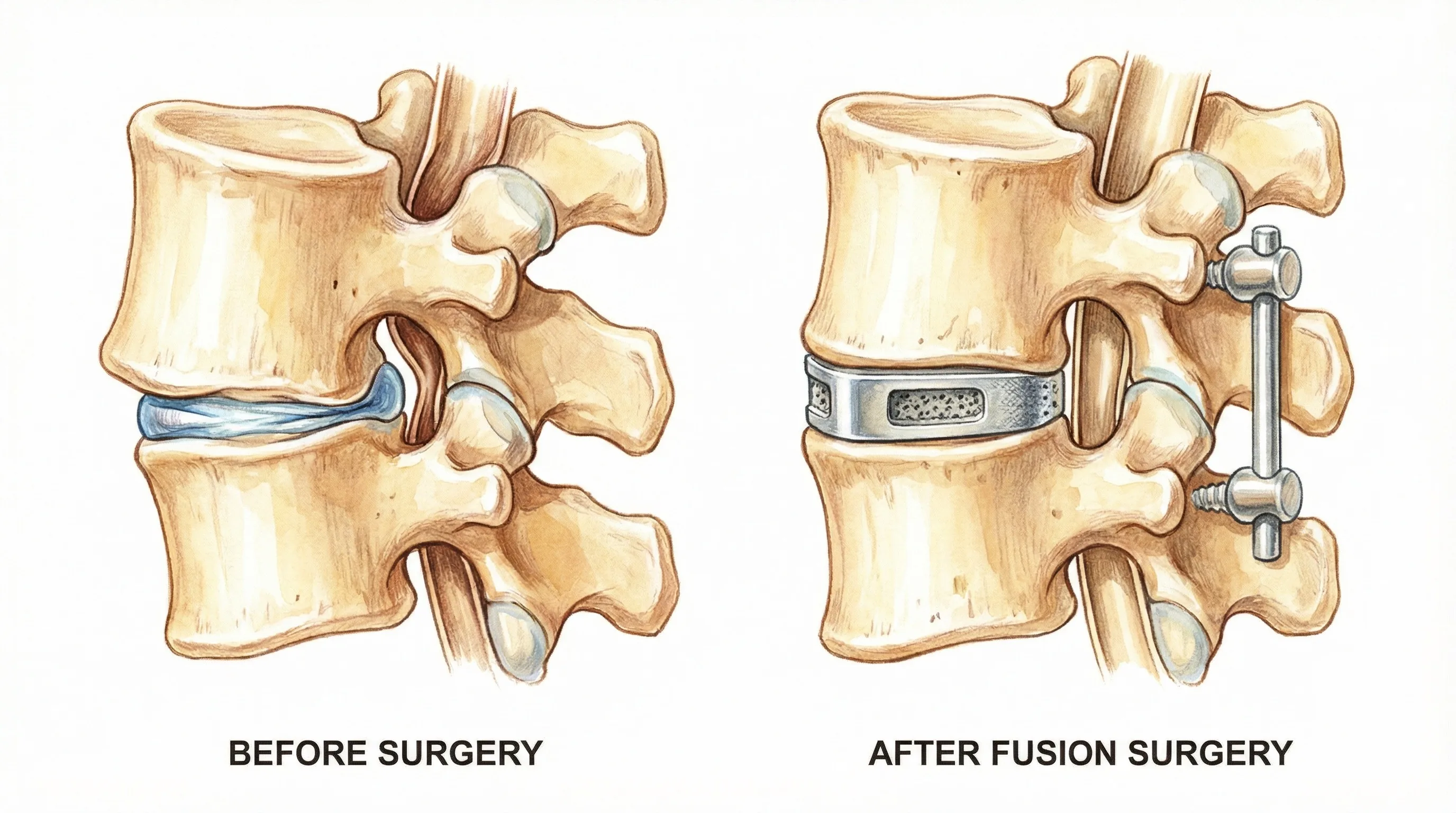
This surgery uses screws and spacers to lock unstable vertebrae firmly in place.
What You'll Learn
What fusion surgery does
When fusion is necessary
What the clinical guidelines recommend (evidence)
Types of fusion (from the back, from the side, from the front)
Minimally invasive fusion (MIS / MISt)
How fusion compares to decompression alone
Risks and complications
Frequently asked questions
1. What Fusion Is and When It Is Needed
What Is Fusion Surgery?
When the bones in your lower back are misaligned or wobbly:
The nerve pathway is more easily compressed
Standing and walking can cause the nerves to be pinched even more
Fusion surgery fixes this by:
Placing a spacer (like a small wedge or block) between the vertebrae
Securing the vertebrae with screws and rods (metal bars) so they can no longer move
Over time, your own bone grows into the space, and the vertebrae fuse into one solid unit
Think of it this way: Imagine a wobbly bookshelf that keeps swaying. Fusion is like bolting it to the wall with brackets and adding a wooden brace inside, so it stands firm and stops moving.
When Is Fusion Necessary?
Decompression surgery (which widens the nerve pathway) is often enough on its own. Fusion may be added when:
Your vertebrae have slipped forward or backward (spondylolisthesis)
X-rays show that your bones move excessively when you bend forward and backward
So much bone needs to be removed for decompression that the spine would become unstable afterward
Your spine has a significant curvature or deformity that throws off your balance
So fusion is considered when widening the pathway is not enough because the bones themselves are unstable (or would become unstable after surgery).
Guideline Criteria for Fusion
Criterion
Specific Threshold
Slippage
5 mm or more
Rotational instability
10 degrees or more
Facet joint angle
Greater than 50 degrees
Disc height
6.5 mm or more
Back pain as the main symptom
Back pain more prominent than leg pain
Extensive decompression needed
Bilateral decompression through a bilateral approach
If none of these criteria apply (meaning instability is minimal), decompression alone usually gives good results, and you avoid the added risks and costs of fusion.
What the Guidelines Recommend (Clinical Practice Guidelines 2021)
Recommendation
Grade
Evidence Level
Fusion with decompression is beneficial for cases with spinal instability, improving quality of life and daily function. However, costs are higher than decompression alone, and return-to-work rates are slightly lower. Complication and reoperation rates also increase, so the indication should be carefully considered based on the condition and surgical approach.
2 (Suggested)
B
Key takeaway: For straightforward lumbar spinal stenosis, the difference between decompression alone and decompression plus fusion is limited, while complications increase with fusion. The guidelines state that routine addition of fusion is not recommended. The question to ask is: "Is fusion truly necessary in my case?"
2. Types of Fusion Surgery
Types of Fusion Surgery
All fusion procedures do the same thing: they stabilize wobbly vertebrae with screws and spacers. They differ in which direction the surgeon approaches from.
1. Posterior Fusion (PLIF / TLIF) — From the Back
The surgeon makes an incision along the center of your back to reach the spine. This approach allows both decompression (widening the nerve pathway) and fusion to be done through the same incision.
The damaged disc (cushion between vertebrae) is removed, and a spacer (cage) packed with bone graft is inserted into the space. Screws are then placed into the vertebrae on both sides and connected with rods.
PLIF (Posterior Lumbar Interbody Fusion)
The spacer is inserted from the back, passing alongside the nerves on both sides. The surgeon sees well this way, but has to handle the nerves more, which slightly increases the risk of nerve injury or dural tears.
TLIF (Transforaminal Lumbar Interbody Fusion)
The spacer is inserted from one side at an angle. This needs less nerve handling than PLIF. TLIF is also well suited to minimally invasive techniques.
Procedure
Approach
Key Feature
PLIF
Posterior, bilateral
Wide view; more nerve retraction
TLIF
Posterior, unilateral
Less nerve handling; easier to do minimally invasively
2. Lateral Fusion (LLIF / XLIF) — From the Side
The surgeon makes a small incision on your side (the flank area), moves the abdominal organs aside, and reaches the spine from the side.
A relatively large spacer is placed between the vertebrae. Its height indirectly widens the nerve pathway from the inside. In most cases, screws are also placed through a separate small incision in the back.
Advantages
The back muscles are not extensively cut
Well-suited for correcting sideways curvature (scoliosis) or treating multiple levels
Disadvantages
The approach passes near nerves going to the legs, which may cause temporary thigh numbness or weakness (this usually improves over time)
Not suitable for all spinal levels due to the position of the pelvis and blood vessels
3. Anterior Fusion (ALIF) — From the Front
The surgeon makes an incision in the lower abdomen (below the navel) and approaches the spine from the front.
The damaged disc is removed from the front, and a large spacer is placed to restore both the height and curve of the spine. Screws are usually added from the back through a separate incision.
Advantages
Allows thorough disc removal and placement of a large spacer to restore spinal alignment
Does not directly touch the back muscles or nerves, so it is sometimes chosen for revision surgery
Disadvantages
The approach passes near major blood vessels and abdominal organs, so there is a risk of injury to blood vessels or organs that the other approaches do not have
May not be suitable for patients with certain body types or previous abdominal surgery
How Is the Right Approach Chosen?
Fusion surgery can be performed from the back, the side, or the front. Each approach aims to stabilize wobbly vertebrae with screws and spacers and protect the nerve pathway.
Your surgeon will choose the approach based on:
Which levels are affected
How much slippage or curvature is present
Your body type and other medical conditions (heart, lungs, abdominal issues)
Previous surgeries
Your goals for quality of life improvement
When the approach suits the patient, outcomes are generally favorable whichever technique is used. No single approach is clearly better than the others. You don't need to memorize these names, but knowing how the choice is made may help you feel more confident.
Minimally Invasive Fusion (MIS / MISt)
What Is MIS?
MIS stands for "Minimally Invasive Surgery": surgery done through small incisions to reduce the strain on your body.
Smaller skin incisions
Less blood loss
Minimal muscle damage
This usually means less pain, getting up sooner, and a shorter hospital stay.
What Is MISt?
MISt stands for "Minimally Invasive Spine Stabilization", a general term for stabilizing the spine through small incisions.
Traditional fusion required a large incision with extensive muscle dissection. With MISt, several small openings are used to insert screws and spacers.
Because blood loss and pain are reduced, MISt allows elderly patients in particular to get back on their feet sooner.
How Do MIS-TLIF and Similar Terms Fit In?
PLIF, TLIF, LLIF, and ALIF can each be performed in either a traditional (open) way or a minimally invasive (MIS) way.
For example:
MIS-TLIF = TLIF performed through small incisions
MIS-PLIF, MIS-LLIF = the same concept applied to other approaches
To sum up:
MIS = Small-incision surgery to reduce the burden on your body (general term)
MISt = The subset of MIS specifically for spine stabilization procedures
3. Comparison with Decompression, and Risks
How Fusion Compares to Decompression Alone
Results from meta-analyses (combined data from multiple studies):
Outcome
Finding
Back pain
Fusion is significantly better (5 studies, 6,294 patients total)
Leg pain
No significant difference (4 studies, 6,243 patients total)
Daily function / Quality of life
Fusion improves outcomes in back pain cases. Significant QOL improvement in spondylolisthesis
Walking ability
No significant difference between approaches
Long-term outcomes
Similar with or without fusion, except with instability, where fusion is better
In plain terms:
If leg pain and numbness are your main problems → Decompression alone is often sufficient
If back pain is your main problem and instability is present → Adding fusion is beneficial
If you have spondylolisthesis → Fusion leads to better long-term results
Risks and Complications
Weighing the Benefits and Drawbacks
Benefits
Drawbacks
Stabilizes the spine
Greater surgical burden (longer surgery, more blood loss)
Can correct deformity
Loss of movement at the fused levels
Effective for back pain
Costs significantly more than decompression alone
Long-term stability
Return-to-work rate is somewhat lower
Favorable long-term results in unstable cases
Increased stress on adjacent segments
Implant issues (screw loosening, breakage) occur in a small percentage
Long-Term Risk — Adjacent Segment Disease
After fusion, the levels above and below the fused segment take on extra stress, which can lead to new problems over time. Understand this risk before you decide on fusion.
For patients with a BMI of 30 or higher, decompression can still work, but symptoms improve in fewer patients than in those without obesity. Also, hospital stays for obese patients undergoing fusion are the longest among all groups.
4. Common Questions, Questions for Your Doctor, and Summary
Frequently Asked Questions
Q. Will my back be stiff if I have fusion?
A. The fused segment will no longer move, but if only 1–2 levels are fused, the effect on your daily movements is generally small. The more levels are fused, the more your range of motion is limited.
Q. Will the metal hardware stay in my body forever?
A. In most cases, it does not need to be removed. If complications such as infection or screw loosening occur, a second surgery to remove the hardware may be necessary.
Q. Should I have decompression or fusion?
A. If there is no instability, decompression alone is often sufficient. When instability is present, adding fusion helps back pain in particular. Ask your surgeon: "Is fusion truly necessary in my case?"
Q. How long will I be in the hospital?
A. Typically about 2–3 weeks for fusion. Minimally invasive approaches (MIS) may shorten this.
Q. When can I return to work?
A. For desk work, about 1–2 months. For physically demanding jobs, 3–6 months. Activity restrictions apply until the bone fully heals (approximately 3–6 months).
Questions to Ask Your Doctor
If fusion surgery is recommended, discuss these questions:
"Why isn't decompression alone sufficient in my case?"
Ask for the specific evidence of instability
"How many levels will be fused?"
The more levels fused, the higher the risk of adjacent segment disease
"Which approach will you use?"
Posterior, lateral, and anterior approaches each carry different risks
"Can this be done with minimally invasive techniques (MIS)?"
May reduce the physical burden and recovery time
"What is my risk for adjacent segment disease?"
Knowing the long-term risks helps you decide
"If pain persists after fusion, what are my options?"
Confirms that other treatments will still be available
Summary
Key Point
Details
Purpose of fusion
Stabilize wobbly vertebrae with screws and spacers
When it's needed
Spondylolisthesis, instability, extensive decompression, back pain as the main symptom
Guideline recommendation
Beneficial for cases with instability (Evidence level B). Routine addition is not recommended
Types of fusion
Posterior (PLIF/TLIF), lateral (LLIF), anterior (ALIF); all generally give good results
Minimally invasive options
MIS/MISt may reduce the physical burden
Compared to decompression
Superior for back pain, but no difference for leg pain. Higher cost and slightly lower return-to-work rate
This page provides medically accurate information, but it is not a substitute for professional medical advice. Please consult your doctor for diagnosis and treatment tailored to your individual situation.