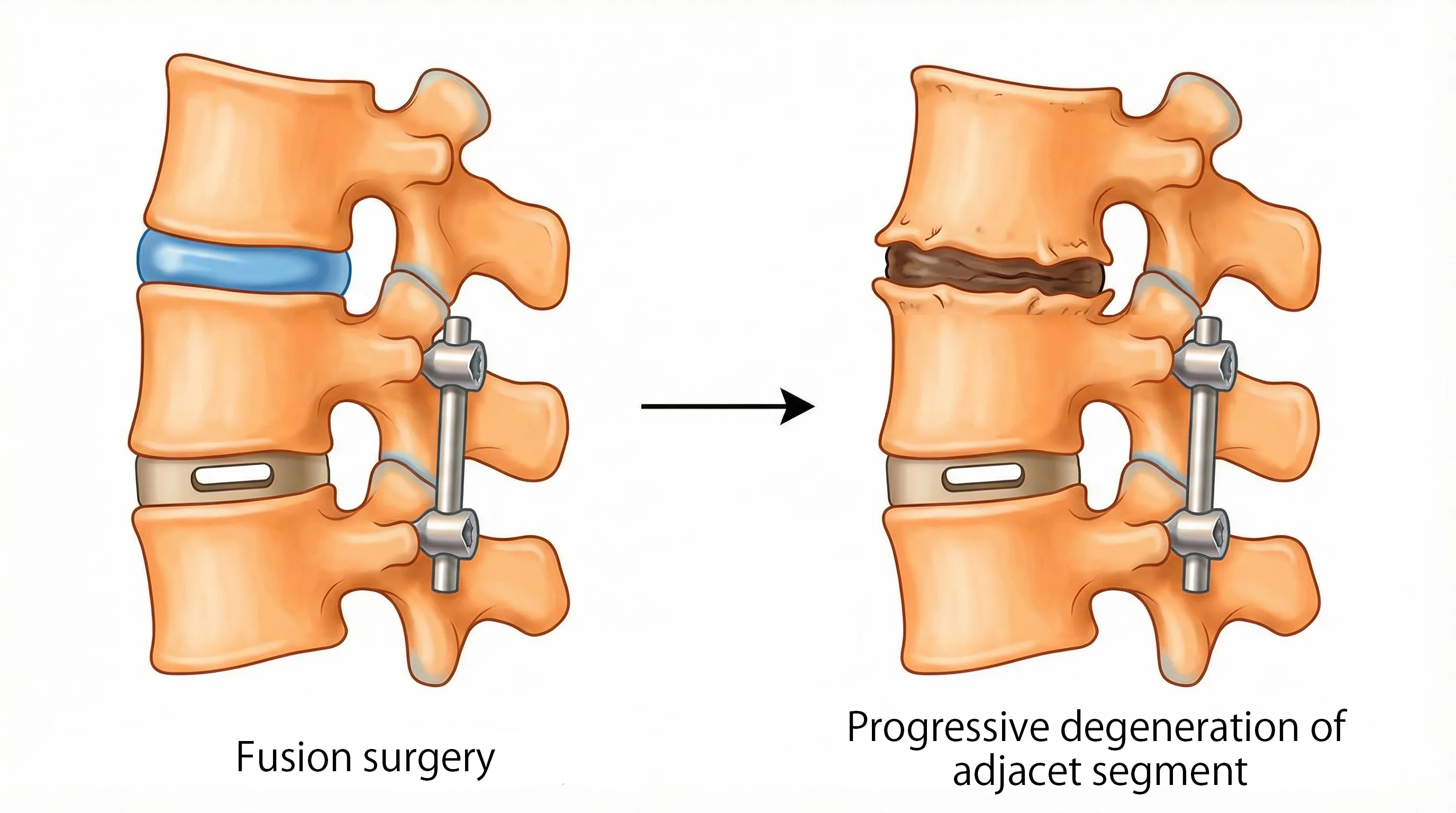
Adjacent segment disease (ASD), the irreversibility of fusion, and why SCS may be an alternative to consider.
Fusion is an effective treatment, but it cannot be undone, so the decision deserves careful thought.
What You'll Learn
What adjacent segment disease (ASD) is
How common it is
Why it happens
The timeline of progression
What symptoms to watch for
How to reduce the risk
What to do if ASD develops
Understanding the irreversibility of fusion
What to consider before deciding on fusion
1. What ASD Is and How Common It Is
What Is Adjacent Segment Disease (ASD)?
Years after lumbar fusion surgery, some patients develop new pain or nerve compression at the levels immediately above or below the fused segment. This is called adjacent segment disease, or ASD for short.
How It Happens
Fusion surgery locks the vertebrae together with screws and rods, making them immovable
Because the fused segment can no longer move, the levels above and below must compensate by moving more
Over years of extra stress:
The disc (cushion) at those neighboring levels wears down faster
The nerve pathway may narrow again
The vertebrae may begin to slip (spondylolisthesis)
Picture a three-drawer dresser with the middle drawer nailed shut. The top and bottom drawers now get pulled open and pushed closed more than before, so over time their rails and frames wear out faster.
How Common Is It?
The numbers vary across studies, but large studies show the following:
After lower back surgery, about 1 in 4 people (about 27%) develop visible changes on X-ray or MRI at neighboring levels
But only about 1 in 12 (about 9%) develop symptoms such as pain or numbness
The proportion who needed another operation at a neighboring level was about 1 in 7 at 5 years and about 1 in 5 at 10 years
In short:
"Many people develop changes at neighboring levels, but most don't experience symptoms"
"But the risk grows with time: roughly 1 in 5 need another surgery by 10 years"
Timeline of Progression
Adjacent segment problems build up over years, not right after surgery. The more levels that are fused, the higher the risk of another operation.
Time / Group
What Happens
Source
Long term (pooled)
Imaging changes in ~27%; symptoms in ~9%
Xia XP et al., Spine 2013 (meta-analysis of 94 studies)
5 years
~14% had surgery at a neighboring level
Sears WR et al., Spine J 2011 (1,000 fusions)
10 years
~22% had surgery at a neighboring level
Same
10 years, by levels fused
1 level 16% · 2 levels 31% · 3–4 levels 40%
Same
Japan
9% reoperated over a mean of 8.3 years
Okuda S et al., Global Spine J 2018 (1,000 patients)
Imaging changes do not equal symptoms: About 27% show changes on scans, but only about 9% have symptoms. The risk does rise steadily over time, and a meaningful share of patients eventually need surgery.
2. Causes, Symptoms, and Prevention
Why Does It Happen?
1. Increased Mechanical Stress
When the fused segment stops moving, the neighboring levels must bend and extend more to compensate. Years of this extra motion accelerates wear on the discs and can lead to slippage.
2. Surgical Impact on Neighboring Structures
During fusion, the bone and ligaments at adjacent levels may be partially removed. This can make those levels less stable and more susceptible to ASD.
Research shows:
Fusion alone: ASD rate of 35.2%
Fusion with laminectomy at the adjacent level: ASD rate of 57.5%
(Simonetta B et al., Spine 2025)
3. Screw Placement
If the screws used for fixation encroach on the facet joint at the neighboring level, the stress on that joint increases, raising the risk of ASD.
4. Spinal Alignment During Fusion
The angle at which the vertebrae are fused has a major impact on neighboring levels. The lower back naturally maintains a forward curve (lordosis) when you stand. Preserving this natural curve during fusion is ideal. If the curve is not maintained, the adjacent levels bear more stress and ASD becomes more likely.
5. Number of Levels Fused
Limiting fusion to the minimum necessary number of levels is important. The five lumbar vertebrae move a lot in daily life. Each level that is fused leaves fewer levels to share the work, so each remaining level carries more.
What Symptoms May Develop?
Many people with adjacent segment changes never develop symptoms. When symptoms do appear, they may include:
Back or lower back pain
New leg numbness or pain (from new nerve compression)
Shorter walking distance
Rarely, bladder or bowel problems (in severe cases)
In other words, symptoms similar to those you had before your original surgery may come back.
How to Reduce the Risk
Choose Surgery Carefully
Ask: "Is fusion truly necessary?" This should be thoroughly evaluated before surgery
Keep the fusion to the minimum number of levels required
Protect Neighboring Structures
During surgery, avoid unnecessary removal of bone and ligaments at adjacent levels
Maintain the Natural Spinal Curve
Preserve the lumbar lordosis (the natural forward curve of the lower back) to minimize stress on neighboring joints
Consider Minimally Invasive Techniques (MIS)
MIS and MISt approaches preserve more muscle and ligament tissue, which may reduce damage to surrounding structures and lower the risk of ASD
Rehabilitate and Strengthen Your Core
After surgery:
Core strengthening exercises (back and abdominal muscles)
Training in proper posture
These help stabilize your entire spine, reducing the extra burden on neighboring levels.
Keep Up with Follow-Up Appointments
ASD typically develops over several years, not immediately after surgery. So it is important to:
Have regular X-rays and MRIs to monitor the health of your spine
Report any new symptoms to your doctor early
3. If ASD Develops, and Irreversibility
What If ASD Develops?
If you have no symptoms, no treatment is needed. Even if imaging shows changes, that alone is not a reason for surgery.
Mild symptoms: Pain medication, rehabilitation, and exercise therapy are used while monitoring your progress
Severe symptoms affecting daily life: Surgery may be recommended to decompress or stabilize the newly affected level
From the guideline commentary:
Whether or not implants were used does not significantly affect the rate of adjacent segment changes. So ASD is not only a fusion problem; it can also occur after decompression alone. Patients who already have degeneration at adjacent levels before surgery tend to have worse outcomes, and those with advanced degeneration have higher rates of new leg symptoms and reoperation.
A prospective database analysis found that the reoperation rate at up to 5 years was approximately 14%, regardless of whether fusion was performed.
Understanding the Irreversibility of Fusion
Fusion is an effective treatment, but it is a decision you cannot undo.
Aspect
What It Means
Permanent fixation
Once vertebrae are fused, they will never move again
Stress redistribution
Permanent extra stress is placed on the levels above and below
Fewer future options
If pain continues after fusion, treatment options become more limited
Diminishing returns with reoperation
Each subsequent surgery tends to be less effective
What you should know:
Fusion done for the right reasons is a highly effective treatment. Still, keep in mind that:
Some patients continue to have pain after surgery
Revision surgeries tend to be less effective than the first operation
For these reasons, your first decision is the most important one
Talk it through with your surgeon, and go ahead only when you are fully comfortable with the decision.
4. Considering SCS, Questions, and Summary
Before Fusion — Considering SCS as an Alternative
There are situations where surgery for nerve decompression or spinal reconstruction is clearly necessary:
Progressive muscle weakness
Bladder or bowel dysfunction
Severe instability or deformity
In these cases, surgery takes priority.
If none of the above apply and your main problem is pain, it may be worth considering spinal cord stimulation (SCS) before committing to an irreversible fusion.
SCS has these advantages:
It can be tried and then reversed if needed (reversible)
It does not carry the risk of adjacent segment disease
It has proven effectiveness for chronic pain, including pain after surgery
If fusion has been recommended, ask your surgeon: "Why isn't decompression alone sufficient?" and "Is fusion truly necessary given my condition?" Then also ask whether SCS might be an option worth exploring.
This page provides medically accurate information, but it is not a substitute for professional medical advice. Please consult your doctor for diagnosis and treatment tailored to your individual situation.