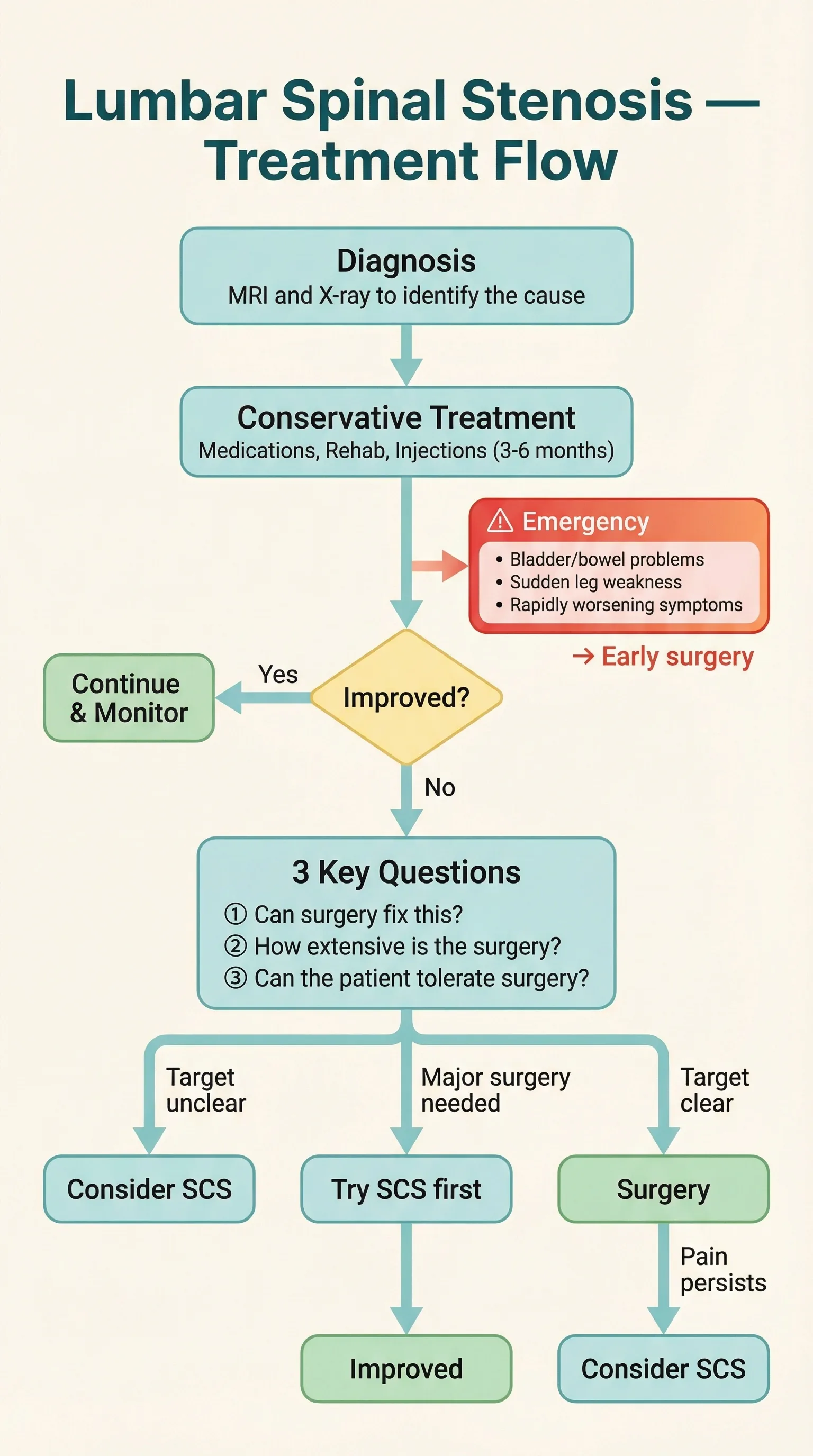
From physical therapy to surgery to spinal cord stimulation — a complete overview of treatment pathways.
You have options, and knowing them is the first step.
What You'll Learn
What treatment options are available (the big picture)
How treatment typically progresses (step by step)
How to think about choosing the right treatment
Why "watchful waiting" can be a valid choice
1. The Treatment Landscape
The Treatment Landscape
Treatment for lumbar spinal stenosis starts with conservative (non-surgical) approaches, then moves to other options based on your individual situation.
Step 1: Conservative Treatment (Non-Surgical)
The first line of treatment includes medications, physical therapy and rehabilitation, epidural steroid injections, and bracing (such as a lumbar corset).
If symptoms don't improve after 3 to 6 months, your doctor will discuss next steps with you.
Step 2: Three Key Questions That Guide Your Treatment
When conservative treatment hasn't brought enough relief, three questions help decide the next step:
1. Can the source of pain be addressed surgically?2. If so, how extensive would the surgery need to be?3. Can the patient safely tolerate that surgery?
The answers point toward one of three paths:
Scenario
When does this apply?
Recommended approach
1. No clear surgical target
Imaging doesn't match symptoms, degeneration spans multiple levels, neuropathic pain is the main issue
Consider spinal cord stimulation (SCS)
2. Surgery is possible, but would require extensive fusion
Multi-level fusion needed, higher surgical risk due to age or other health conditions, significant physical toll
SCS may be worth trying first
3. Clear surgical target with manageable risk
Well-defined area of compression, single-level stenosis, structural instability present
Surgery (decompression or fusion)
Key point: SCS is not a "last resort." The more spinal levels that need to be fused, the greater the physical toll on your body. In those situations, trying SCS first to see if it helps your pain is a reasonable option. SCS is reversible, so your future treatment choices stay open.
When Pain Persists After Surgery
For patients who have had surgery but still experience ongoing pain, spinal cord stimulation (SCS) may also be considered. Even when the structural problem has been corrected, nerve-related pain can continue, and SCS can help with that.
A note from the supervising physician:
The approach above, especially positioning SCS as an option before surgery in certain cases, is based on clinical experience and current evidence. SCS used to be mainly for pain that persisted after surgery. More doctors now recognize that SCS can also help when imaging doesn't clearly match symptoms, when degeneration spans multiple levels, and when surgery is feasible but would require extensive multi-level fusion with significant physical burden.
This approach is not agreed upon by all physicians, and recommendations may vary between doctors and institutions. Please talk these options through with your own doctor.
A Closer Look at Each Treatment
Step 1: Conservative Treatment
These are non-surgical treatments. They usually combine medications, exercise and physical therapy, epidural steroid injections, and bracing. Most patients start here, and if symptoms don't improve after 3 to 6 months, the next step is considered.
If symptoms persist after 3 to 6 months of conservative care, the following options are considered.
Surgery (When There Is a Clear Surgical Target)
Surgery is chosen when the source of compression is clear and a relatively simple procedure is expected to help. When multiple spinal levels need to be fused, the physical demands rise sharply, so it is important to weigh SCS as an alternative.
SCS can be considered early, depending on the situation, rather than kept as a "last resort." There are three main scenarios:
Feature
Details
How it works
A small device is implanted that delivers gentle electrical signals to the spinal cord
What makes it unique
You can try it for about one week first; if it works, you proceed with permanent implantation
Key advantage
It's reversible, so your future options stay open
Scenario 1: No clear surgical target
SCS may be considered as an alternative to surgery when:
Imaging findings don't match the symptoms (stenosis is visible, but may not be the main cause of pain)
Degeneration spans multiple spinal levels
Neuropathic (nerve-related) pain is the primary issue
Scenario 2: Surgery is possible, but would require extensive fusion
SCS may be tried first when:
Multiple levels need to be fused, making surgery a major undertaking
Age or other health conditions raise the surgical risk
The patient is relatively young and wishes to preserve spinal mobility for the future
Reversibility matters: SCS can be removed, but fusion cannot be undone
The more levels that need fusion, the greater the surgical burden and recovery time. In these cases, trying SCS first to see whether it relieves the pain is sensible.
Scenario 3: Pain persists after surgery
SCS may be considered when:
Surgery corrected the structural problem, but nerve-related pain continues
Reoperation carries high risk
The pain involves mechanisms that surgery cannot address
Q. Will my condition only get better with surgery?
A. Not necessarily. Many patients get good relief from conservative treatment alone. Spinal stenosis is a progressive condition, though, so regular follow-up with your doctor is important even if you feel better.
Q. Will surgery completely cure my pain?
A. Surgery improves symptoms for most patients, but it doesn't always eliminate pain entirely. Stenosis may also develop at a different level in the future.
Q. Am I too old for surgery?
A. Age alone does not determine whether surgery is possible. The decision depends on your overall health and any other medical conditions. Patients in their 80s and even 90s have undergone successful spinal surgery.
Q. Who is a good candidate for SCS?
A. There are three main scenarios where SCS is considered: (1) when there is no clear surgical target (imaging doesn't match symptoms, multi-level degeneration, etc.), (2) when surgery is possible but would require extensive multi-level fusion with significant physical burden, and (3) when pain persists after surgery due to ongoing nerve-related pain. In scenario 2 especially, trying SCS before committing to a major fusion surgery is a reasonable option. For more details, see About SCS.
4. Summary, Questions, and Notes for Family
Summary
Key takeaway
Details
Start with conservative treatment
The starting point for all patients
Three questions guide the decision
1. Can surgery address the pain? 2. How extensive? 3. Can the patient tolerate it?
Surgery
When there is a clear target and surgical risk is manageable
SCS (Scenario 1)
When there is no clear surgical target, multi-level degeneration, or mainly neuropathic pain
SCS (Scenario 2)
When surgery is possible but would require extensive multi-level fusion
SCS (Scenario 3)
When pain persists after surgery
Watchful waiting
A valid choice when symptoms are mild
Questions to Ask Your Doctor
Asking questions is important, and it is not rude:
You might feel you should just "leave it to the doctor." But no one knows your body better than you do. Your doctor needs to hear from you where the pain is, how severe it is, and when it is at its worst. Asking questions leads to better care.
Here are some questions to bring to your next appointment:
"Given my symptoms, which treatment would you recommend starting with?"
This tells you the best starting point for your situation
"How long should I try conservative treatment before considering other options?"
This gives you a clear timeline so you can plan ahead
"In my case, can surgery address the source of my pain? How extensive would the surgery be?"
This clarifies whether a surgical target exists and the scope of the procedure (e.g., how many levels would need to be fused)
"Could spinal cord stimulation (SCS) be an option for me?"
Especially if extensive fusion is being considered, it's worth asking whether trying SCS first makes sense
"Given my age and overall health, is surgery a safe option for me?"
This covers whether surgery is possible and safe for you
"If we decide to wait and monitor, what symptoms should prompt me to come back right away?"
So you know the warning signs (loss of bladder/bowel control, sudden leg weakness)
"What are the success rates for each treatment option?"
Realistic expectations help you make an informed decision
Tip:
Bring this treatment comparison page with you to your appointment. Asking "Which of these options would you recommend for my situation?" can help your doctor give you a more specific explanation.
For Family Members
Watching a loved one live with chronic pain is hard. You want to help, but you may not know how.
Here are some things you can do:
Go to appointments together. You can help say things your loved one might find hard to say.
Read through this information together. Deciding is easier when you both know the options.
Make it safe to talk about pain. Let them know it's okay to say "I'm hurting" without feeling like a burden.
Help prepare questions for the doctor. You could print the question list above to bring along.
This page provides medically accurate information for educational purposes. For diagnosis and treatment decisions specific to your situation, please consult your physician.