Types of spinal surgery, when it's recommended, risks, and what to expect — a comprehensive overview.
Surgery is one of your treatment options, not only a "last resort."
What You'll Learn
When surgery should be considered
The types of surgery and how to choose (decompression vs. fusion)
What the clinical guidelines say
Risks and complications
Recovery after surgery
What happens if pain persists after surgery
Questions to ask your doctor
Each type of surgery has its own page with more detail.
1. When to Consider Surgery and Which Type
When to Consider Surgery
Situations Where Surgery May Be Recommended
Situation
Explanation
Conservative treatment hasn't helped
No improvement after 3–6 months of non-surgical treatment
Daily life is significantly affected
Unable to walk or work
Worsening nerve symptoms
Leg weakness or loss of sensation
Bladder or bowel problems
May require emergency surgery
When It's Urgent
The following symptoms may require immediate surgical evaluation:
Signs of Cauda Equina Syndrome
Difficulty urinating or having bowel movements, or loss of control
Numbness in the groin or genital area
Sudden weakness in both legs
These signs mean your nerves are under severe pressure. Without prompt treatment, recovery may be harder.
Types of Surgery and How to Choose
Surgery for lumbar spinal stenosis (LSS) falls into two main categories: decompression and fusion.
Decompression — Relieving Pressure on the Nerves
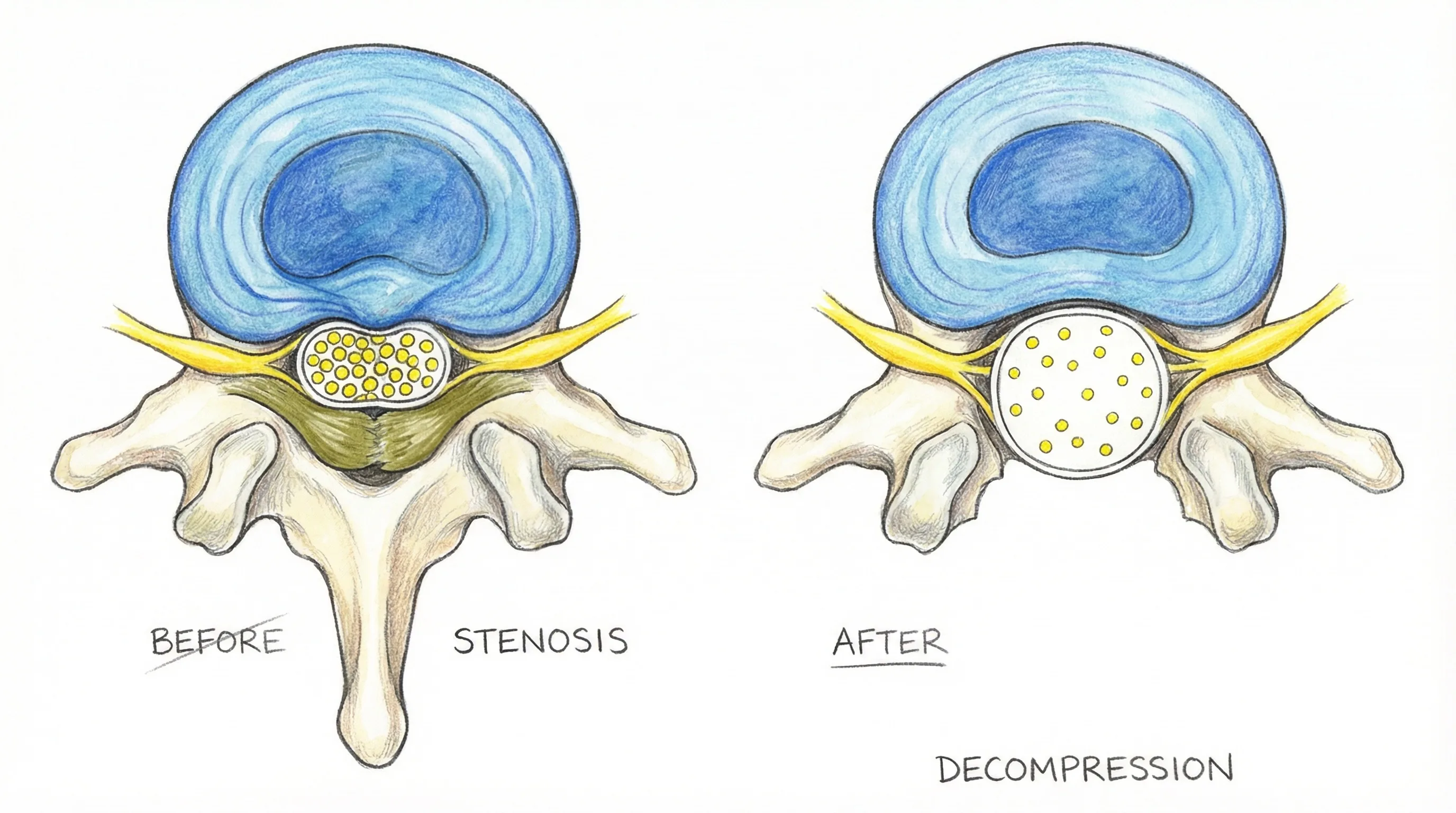
Decompression surgery removes bone and thickened ligaments that press on your nerves, so the nerves have more room.
Think of it this way: Imagine a tunnel whose ceiling has partly collapsed. Decompression shaves away the ceiling to open the tunnel again.
Guideline recommendation: For LSS without instability where conservative treatment has not been effective, decompression surgery is recommended (Recommendation grade 2, Evidence level B).
Main types: Laminectomy, laminoplasty, partial laminectomy, endoscopic surgery
Outcomes: Results are better than conservative treatment at 2 years, though the difference narrows over time. Many patients in the conservative treatment groups later had surgery, which suggests early surgery may help in more severe cases.
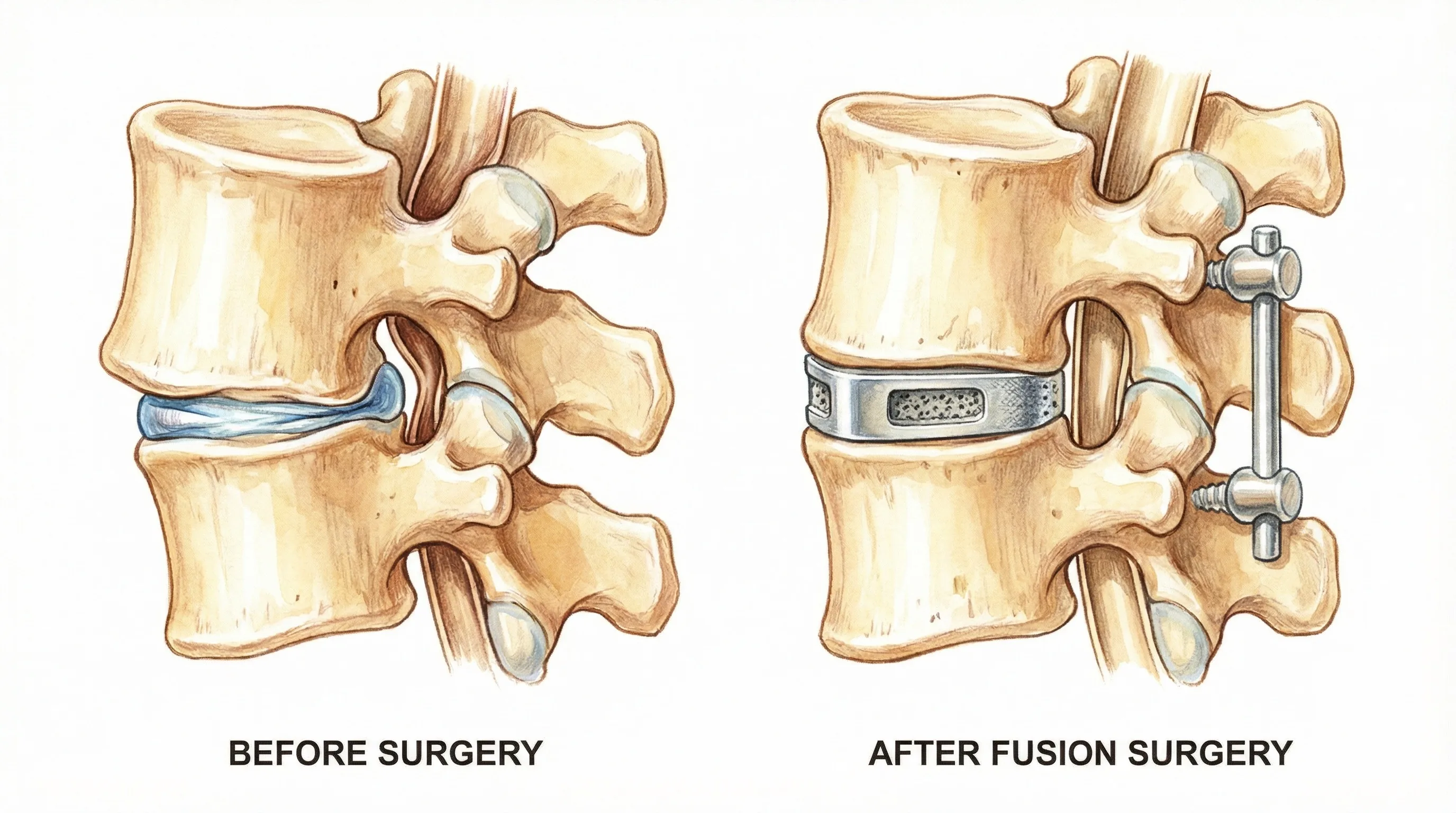
Fusion surgery uses screws and spacers to lock unstable vertebrae in place. It is usually performed together with decompression.
Think of it this way: Imagine a wobbly bookshelf. Fusion bolts it to the wall with brackets so it no longer sways.
Guideline recommendation: Fusion is beneficial for cases with spinal instability. However, routinely adding fusion to decompression is not recommended (Recommendation grade 2, Evidence level B).
When fusion may be considered: Slippage of 5 mm or more, rotational instability of 10 degrees or more, back pain as the primary symptom, or when extensive decompression would compromise spinal stability.
Outcomes: Compared with decompression alone, fusion gives clearly better results for back pain and no difference for leg pain. Long-term results are good in patients with confirmed instability.
Important note: Fusion is an irreversible decision. The segments above and below the fused area take on extra stress, which can lead to "adjacent segment disease" (ASD). A sizable share of patients may later need more surgery because of it.
Minimally invasive techniques do the same procedures through much smaller incisions. Both decompression and fusion can be done this way.
Advantages
Disadvantages
Smaller incision, less pain
Not suitable for every case
Less blood loss
Requires advanced surgical skill and experience
Faster recovery, shorter hospital stay
Available at fewer facilities
Greater benefit for elderly patients
Limited surgical field of view
Decompression vs. Fusion — At a Glance
Factor
Decompression
Fusion
Goal
Remove pressure on the nerves
Stabilize unstable vertebrae
Best for
LSS without instability
LSS with instability, slippage, or deformity
Surgery time
About 1–2 hours
2–3 hours or more
Hospital stay
1–2 weeks
2–3 weeks
Effect on back pain
Moderate
Superior
Effect on leg pain
Excellent
No significant difference
Cost
Lower
Higher
Return to work
Good
Somewhat lower
Reversibility
Relatively reversible
Irreversible (permanent)
Long-term risk
Possible instability
Adjacent segment disease (ASD)
2. Risks and Recovery
Risks and Complications
Every Surgery Carries Some Risk
Your surgical team takes every precaution to keep you safe, but no surgery is completely free of risk.
Main Risks
Risk
Frequency
Explanation
Infection (SSI)
Uncommon
Wound or deep infection; may require additional surgery
Dural tear
Not rare
The membrane surrounding the spinal cord may be damaged
Nerve injury
Rare
Numbness, weakness, or paralysis in the legs
Bleeding
Rare
May require blood transfusion
Deep vein thrombosis
Rare
Blood clots forming in the leg veins
Implant-related issues
Uncommon
Screw loosening or breakage (with fusion)
Reoperation
Not uncommon
Risk increases with longer follow-up
Guideline data on complications: Complication rates vary between studies because definitions and follow-up periods differ. A systematic review of several randomized controlled trials found no significant difference in complication rates between surgical and conservative treatment groups.
How to Reduce Your Risk
Quit smoking. Smoking increases infection risk.
Manage blood sugar, especially if you have diabetes.
Eat well. Good health before surgery helps recovery.
Get up and move soon after surgery.
A Note for Patients with Obesity
For patients with a BMI of 30 or higher, decompression surgery can still work, but symptoms improve less often than in patients without obesity. Back pain is also more likely to remain after decompression alone.
Recovery After Surgery
Recovery Timeline
Time After Surgery
What to Expect
1 week
Begin walking, practice daily activities
2–4 weeks
Discharge from hospital, resume home life
1–3 months
Light work and household tasks become possible
3–6 months
Most activities become possible
6 months–1 year
Full recovery
For fusion patients, activity restrictions apply until the bone fully heals (approximately 3–6 months).
What to Watch For
Period
Key Points
Immediately after
Wound care, pain management
After discharge
Avoid heavy lifting, don't twist your back
During recovery
Continue prescribed rehabilitation exercises
Long-term
Attend regular follow-up appointments
The Cost Perspective
Research comparing surgical and conservative treatment groups found that the average cost was higher in the conservative treatment group. Many of those patients later crossed over to surgery.
Continuing conservative treatment that is not working, with no end point, is a burden for patients and is also not cost-effective.
3. When Pain Persists, and Common Questions
When Pain Persists After Surgery
Sometimes pain remains or new pain develops after surgery. This is called failed back surgery syndrome (FBSS), and it is fairly common.
Why Pain May Persist
Cause
Explanation
Problems at other levels
Stenosis at levels not addressed by surgery
Incomplete decompression
Not all pressure was fully relieved
Scar tissue
Post-surgical scarring may compress nerves
Adjacent segment disease
Levels above or below a fusion deteriorate
Chronic pain sensitization
The nervous system has become hypersensitive to pain
A. Age alone does not determine whether you can have surgery. Many patients in their 80s and even 90s undergo successful surgery. The decision weighs your overall health, other medical conditions, and your own wishes together.
Q. Will surgery cure me completely?
A. Most patients improve a great deal, but being "completely pain-free" is not guaranteed. Because spinal stenosis is caused by age-related changes, new narrowing can develop at other levels over time.
Q. Do I need decompression or fusion?
A. If there is no instability, decompression alone is often sufficient. When instability is present, adding fusion works especially well for back pain. The decompression and fusion pages explain each option in detail.
Q. How long will I be in the hospital?
A. Typically 1–2 weeks for decompression, and 2–3 weeks for fusion. Minimally invasive approaches may shorten this.
Q. When can I return to work?
A. For desk work, about 1–2 months. For physically demanding jobs, 3–6 months is typical. Fusion patients may need longer.
4. Questions, Summary, and References
Questions to Ask Your Doctor
These questions can help you decide about surgery:
"Do I need decompression only, or is fusion also necessary?"
Tells you how extensive your surgery will be
"Am I a candidate for minimally invasive surgery (endoscopic or microscopic)?"
Finds out whether a less invasive approach is possible for you
"How much improvement can I realistically expect? Will the pain go away completely?"
Realistic expectations lead to greater satisfaction
"Given my age and overall health, can surgery be performed safely?"
Confirms that your risk factors have been checked carefully
"What is likely to happen if I don't have surgery?"
Compares the long-term outlook of surgery with continued conservative care
"How long will I be in the hospital, and when can I return to work?"
Helps you plan your daily life and work
"What is the chance that pain will persist after surgery, and what can be done about it?"
Prepares you for possible pain after surgery and what can be done
"If fusion is recommended, what is my risk for adjacent segment disease?"
Helps you weigh the long-term risks
"I'd like to get a second opinion. What records should I bring?"
So you have referral letters, MRI images, and surgical plans ready
"After surgery, will other treatment options like SCS still be available to me?"
Confirms that future options stay open
Summary
Key Point
Details
When to consider surgery
Conservative treatment hasn't helped, nerve symptoms are worsening
Decompression
Recommended for LSS without instability. Superior to conservative treatment at 2 years → Details
Fusion
Beneficial for cases with instability. Effective for back pain but irreversible → Details
Fusion risks
Adjacent segment disease is a concern. Because fusion is irreversible, less invasive options such as SCS may be worth discussing with your doctor first, especially for elderly or high-risk patients, since surgery remains available if SCS does not provide sufficient relief. Note: SCS availability and insurance coverage vary by country and provider; ask your doctor whether this option is accessible to you → Details
Minimally invasive surgery
Smaller incisions. Greater benefit for elderly patients
Conflict of Interest Disclosure: This website is operated by a physician who performs both spinal surgery and spinal cord stimulation (SCS) procedures. This page presents surgical options, including their risks and limitations, based on clinical guidelines and published evidence. Your surgical decisions should be made together with your own healthcare provider after considering all available options.
Japanese Orthopaedic Association (JOA). Clinical Practice Guidelines for Lumbar Spinal Stenosis. 2021.
NICE. Low back pain and sciatica in over 16s: assessment and management. NG59. Updated 2020.
North American Spine Society (NASS). Evidence-Based Clinical Guidelines for Lumbar Spine Disorders.
This page provides medically accurate information, but it is not a substitute for professional medical advice. Please consult your doctor for diagnosis and treatment tailored to your individual situation.