How pain works, why you have both back and leg pain, and what makes chronic pain different — the science explained simply.
When you understand why you hurt, the purpose of each treatment begins to make sense.
What You'll Learn
How pain works (the three components: body, emotions, and thoughts)
The two types of pain: nociceptive pain and neuropathic pain
What happens when a nerve is compressed
Why you have both back pain and leg pain
Why walking makes it worse (intermittent claudication)
What chronic pain is and how it develops
Common misconceptions about pain
1. How Pain Works
How Pain Reaches Your Brain
Pain Is a Signal
Pain is a warning signal from your body.
Your nerves send electrical signals to your brain to say, "There's a problem here!"
A problem anywhere along this pathway can change how you feel pain.
Pain Is Not Just a Physical Problem
Research has shown that pain has three components:
Component
What It Means
Example
Sensation
The physical pain signal itself
"It throbs," "It tingles"
Emotion
The unpleasant feelings that come with pain
Anxiety, frustration, feeling down
Cognition (thought)
How you interpret and think about your pain
"What if it never gets better?" "Moving will make it worse"
So how strongly you feel pain depends on more than your physical condition. Your emotions and how you think about the pain also play a part.
An important point:
This does not mean the pain is "all in your head." All three components are real processes in your brain. That is why managing how you relate to your pain is a proper part of treatment, alongside treating the body.
Two Types of Pain -- Nociceptive Pain and Neuropathic Pain
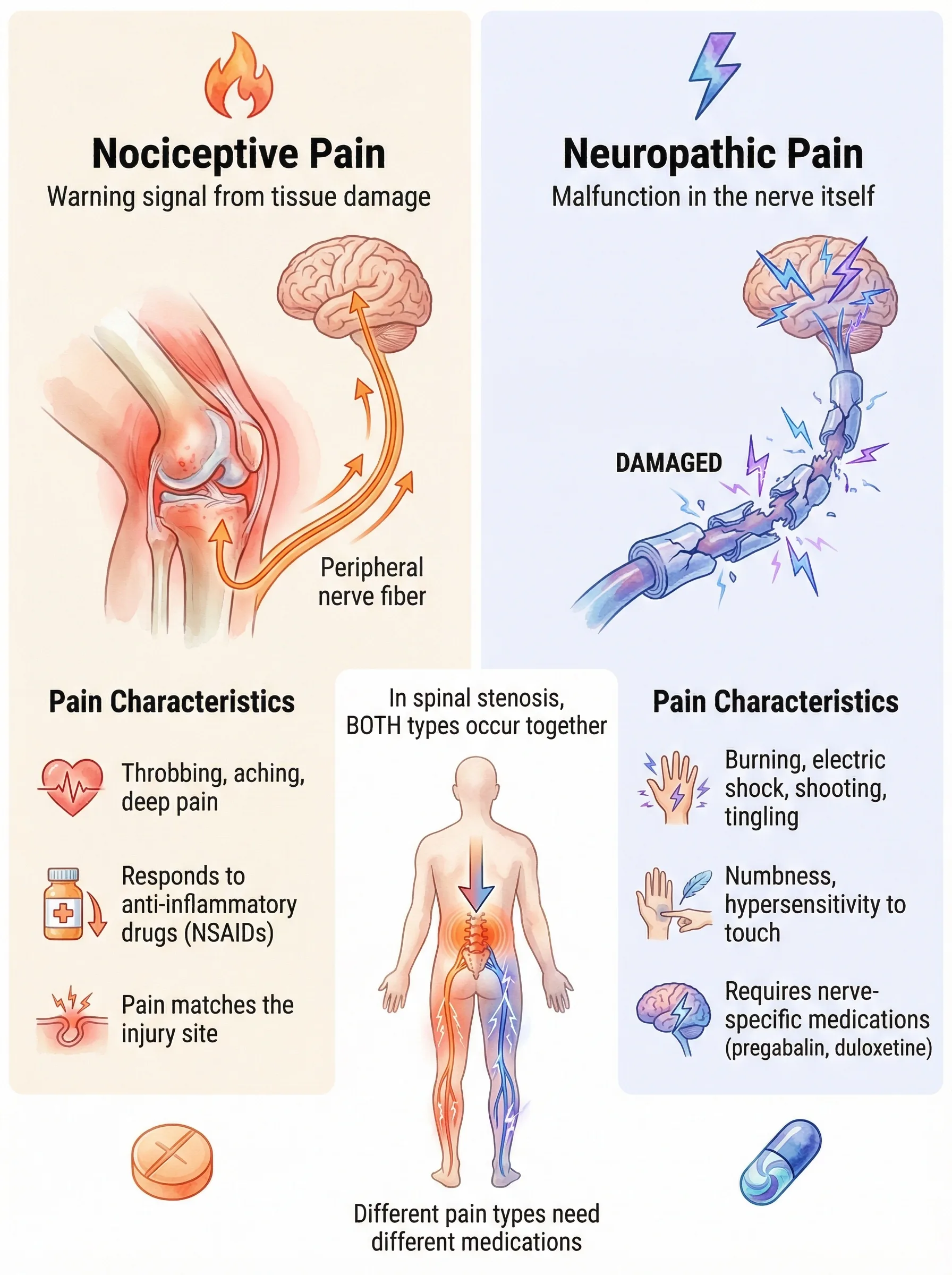
There are two main types of pain. Each responds to different medications, so it helps to know which you have.
Nociceptive Pain
This is the pain you feel when tissue in your body is injured or inflamed. Nociceptive pain is a warning signal, like the pain you feel when you touch something sharp or hot and pull your hand away.
Feature
Details
What does it feel like?
Throbbing, aching, a deep or heavy pain
Causes
Fractures, joint inflammation, muscle strain, etc.
Effective medications
Anti-inflammatory painkillers (NSAIDs) such as ibuprofen or naproxen
Key characteristic
A "warning" pain that protects your body
Neuropathic Pain
This is pain caused by damage or malfunction in the nerve itself.
Feature
Details
What does it feel like?
Burning, electric shock-like, shooting, stinging
Accompanying symptoms
Numbness, reduced sensation, pain from light touch
Effective medications
Gabapentinoids (e.g., pregabalin, mirogabalin), duloxetine (ordinary painkillers are often ineffective)
Key characteristic
Pain from a nerve "malfunction"
Which Type of Pain Occurs in Spinal Stenosis?
In lumbar spinal stenosis, both types of pain often occur together.
This is why you may need several different medications:
Anti-inflammatory drugs treat your back pain, and nerve-specific medications treat leg numbness and pain: different types of pain need different medications. It may feel like a lot of pills, but each one targets a different type of pain.
2. Nerve Compression and Your Symptoms
What Happens When a Nerve Is Compressed
Think of It This Way: Nerves Are Like Electrical Wires
Your nerves are like electrical wires running throughout your body.
They carry commands from the brain to the body, and sensations from the body back to the brain.
When a Nerve Is Compressed...
A compressed nerve is like a squeezed electrical wire. When its signals are disrupted, these symptoms can occur:
Symptom
What Is Happening
Pain
The nerve is sending a "there's a problem!" signal
Numbness
Sensory signals are not being transmitted properly
Reduced sensation
You cannot feel touch as well as normal
Muscle weakness
The "move" command is not reaching your muscles properly
Back Pain and Leg Pain -- Why Do You Have Both?
Why Your Back Hurts
When there is a problem with the lumbar spine itself (the bones, discs, joints, or muscles), you feel pain in your lower back.
This is pain coming directly from the site of the problem.
Why Your Leg Hurts or Feels Numb
So why does your leg hurt or feel numb, even though the problem is in your back?
The nerves in your lower back travel down into your legs.
So:
The nerve is being compressed in your lower back, but the symptoms appear in your leg.
This is called radiating pain or referred pain.
The Location of Your Symptoms Depends on Which Nerve Is Compressed
Compressed Nerve
Where Symptoms Typically Appear
L4 nerve root
Front of the thigh, inner side of the knee
L5 nerve root
Outer thigh, outer shin, top of the foot, big toe
S1 nerve root
Calf, sole of the foot, little toe side
Your doctor can often determine which nerve is being compressed based on where you feel your symptoms.
Why Walking Makes It Worse -- Intermittent Claudication
What Is Intermittent Claudication?
The most typical symptom of spinal stenosis is intermittent claudication.
Intermittent claudication means:
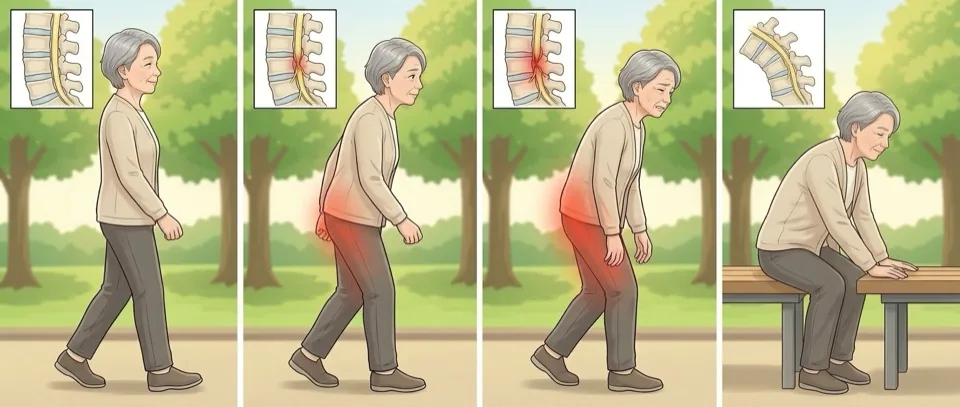
While walking, your legs become painful or numb, and you have to stop. After a short rest, especially if you lean forward, the symptoms ease and you can walk again. This cycle repeats over and over.
Why Does This Happen?
When you stand and walk, your lower back naturally arches backward.
When your back arches, the ligamentum flavum buckles inward, making the spinal canal even narrower.
This increases pressure on the nerves and brings on your symptoms.
When the body extends, the nerves are compressed and sciatica appears. When leaning forward, the compression is relieved and the pain subsides.
Why Leaning Forward Helps
When you lean forward, your lower back rounds.
When your back rounds, the ligamentum flavum is stretched thin, and the spinal canal opens up.
This reduces pressure on the nerves, and you feel better.
That is why:
Pushing a shopping cart feels comfortable
You can ride a bicycle without trouble
Sitting in a chair brings relief
All of these positions involve leaning forward, which widens the spinal canal.
3. Chronic Pain and How It Is Treated
What Is Chronic Pain?
When Pain Persists...
Normally, pain is a "warning signal." Once the problem is resolved, the pain should go away.
When pain lasts longer than three months, it can develop into a condition called chronic pain. Studies show that roughly 15% of the general population lives with chronic pain, and among those aged 75 and older, this rises to about 37%. Chronic pain becomes more common with age.
From Acute Pain to Chronic Pain -- How the Nervous System Changes
In chronic pain, the nervous system itself undergoes gradual changes.
An important point:
Chronic pain is not "imaginary," and it has nothing to do with "not being tough enough." The nervous system itself has physically changed. That is why you should treat pain properly at an early stage. Some people refuse painkillers because they worry the medication will stop working when they "really need it," or because of side effects. Sometimes pain goes away on its own. But in conditions like lumbar spinal stenosis where pain persists, putting up with it can let the nerves become more and more sensitive until the pain is truly unbearable. And once chronic pain is established, it is much harder to treat.
Your Body Has a Built-In Pain Control System
Your body has a built-in mechanism for suppressing pain.
The brainstem sends chemical messengers, serotonin and norepinephrine, down to the spinal cord, where they act as a brake on pain signals.
When chronic pain persists, this braking system can weaken or even start amplifying pain instead.
How this relates to your medications:
Drugs like duloxetine (Cymbalta), tramadol, and neurotropin work by strengthening this "natural braking system." They work differently from ordinary painkillers, so they can help pain that does not respond to standard pain medications.
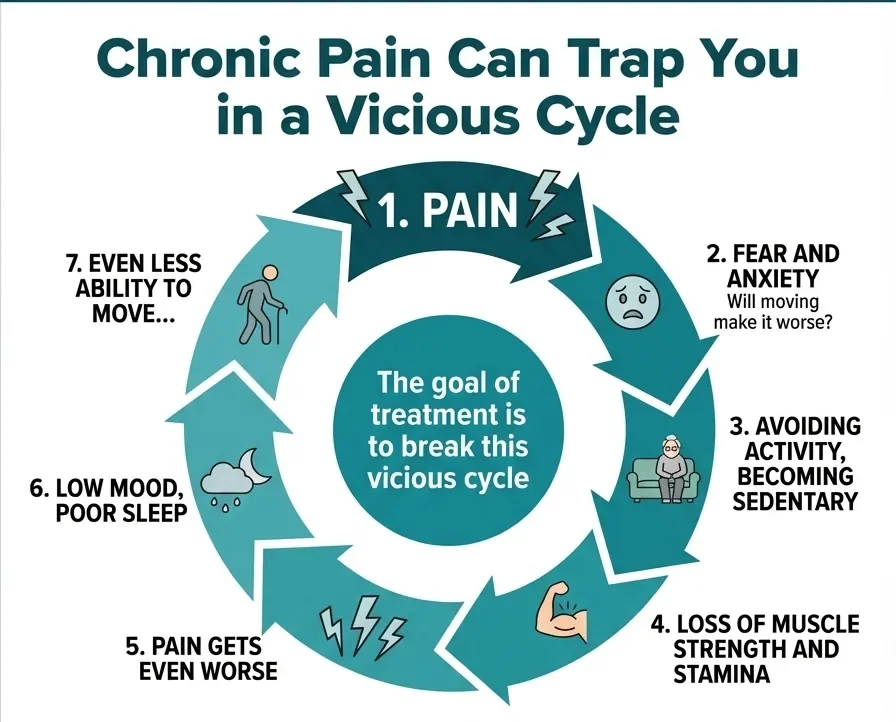
The Vicious Cycle of Pain
Chronic pain often traps people in a vicious cycle.
In older adults, age-related changes make this cycle worse.
Contributing Factor
Impact
Muscle loss (sarcopenia)
Less support for your body, more pain
Balance problems
Higher risk of falls
Osteoporosis
Higher risk of fractures
Reduced appetite
Poor nutrition slows recovery
The goal of treatment:
Treatment aims to break this vicious cycle.
Relieve your pain (medications, nerve blocks, spinal cord stimulation, etc.)
Improve your daily function (rehabilitation, exercise therapy)
Restore your quality of life (expand the things you can do)
Common Misconceptions About Pain
Do any of these mistaken beliefs shape how you think about your pain?
Common Misconception
The Reality
"Something must be damaged for there to be pain"
Pain can occur even without tissue damage
"The abnormalities on my X-ray or MRI are causing my pain"
Imaging findings and pain often do not match
"Moving is dangerous; rest is best"
Appropriate activity helps recovery
"If I can tolerate the pain, I should just leave it alone"
Even mild pain can become chronic if left untreated
"Painkillers are bad for your body"
Used properly, they are an essential tool for preventing the pain cycle
Painkillers are like a fire extinguisher:
A fire extinguisher can put out a small fire, but not a blaze that is out of control. Pain works the same way, so catch it early. When you feel pain, your painkiller works best if you take it within 30 minutes instead of trying to tough it out.
How Pain Treatment Works
Once you know how pain works, the purpose of each treatment is easier to see.
Treatment
What It Does
Which Type of Pain?
Anti-inflammatory drugs (NSAIDs)
Reduce inflammation and decrease pain signals
Mainly nociceptive pain
Nerve medications (e.g., pregabalin)
Calm abnormal nerve excitability
Neuropathic pain
Descending inhibition boosters (e.g., duloxetine)
Strengthen the brain's pain-suppression pathway to the spinal cord
Chronic pain, neuropathic pain
Nerve block injections
Temporarily stop signals in a specific nerve
Both types
Surgery (decompression)
Physically remove the pressure on the nerve
Pain caused by compression
Spinal cord stimulation (SCS)
Deliver electrical stimulation to the spinal cord, making it harder for pain signals to reach the brain
Neuropathic pain, chronic pain
Each treatment works at a different point along the pain pathway.
4. Summary and Questions for Your Doctor
Summary
Key Point
Details
Pain has three components
Sensation, emotion, and thought all influence how much pain you feel
Two types of pain
Nociceptive (inflammatory) and neuropathic (nerve malfunction)
Leg symptoms
When nerves are compressed in the lower back, symptoms appear in the legs
Medications: how different medications target different types of pain
Questions to Ask Your Doctor
Consider asking these questions at your next appointment:
"Is my pain nociceptive, neuropathic, or both?"
The type of pain determines which medications are most effective. Knowing your pain type helps you understand why each medication was prescribed
"Based on my leg symptoms, which nerve do you think is being compressed?"
This helps confirm whether it is the L4, L5, or S1 nerve root that is affected
"Has my pain progressed to a chronic stage?"
If your pain has become chronic, additional treatments targeting the nervous system may be needed
"Am I at risk for a pain vicious cycle? What should I watch out for?"
This helps you spot warning signs such as doing less than before or low mood
"Given the current state of my pain, which treatments are most appropriate?"
This tells you which treatments fit the way your pain works
Tip:
Drawing a picture of where your pain and numbness occur and showing it to your doctor can help pinpoint which nerve is compressed. Also, descriptions like "burning," "electric shock-like," or "tingling" are signs of neuropathic pain. Describing the quality of your pain, not just where it is, helps with diagnosis.
This page provides medically accurate information, but it is not a substitute for professional medical advice. Please consult your doctor for diagnosis and treatment tailored to your individual situation.

 When the body extends, the nerves are compressed and sciatica appears. When leaning forward, the compression is relieved and the pain subsides.