Practical tips for daily activities, posture, sleep, and staying active while managing your symptoms.
Even with pain, there is a lot you can do.
What You'll Learn
- How posture and movement affect your symptoms
- Exercise tips and recommendations
- Managing work and household tasks
- The connection between sleep and pain
- Coping with pain emotionally
- A message for family members and caregivers
1. Posture, Movement, and Exercise
Posture and Movement Tips
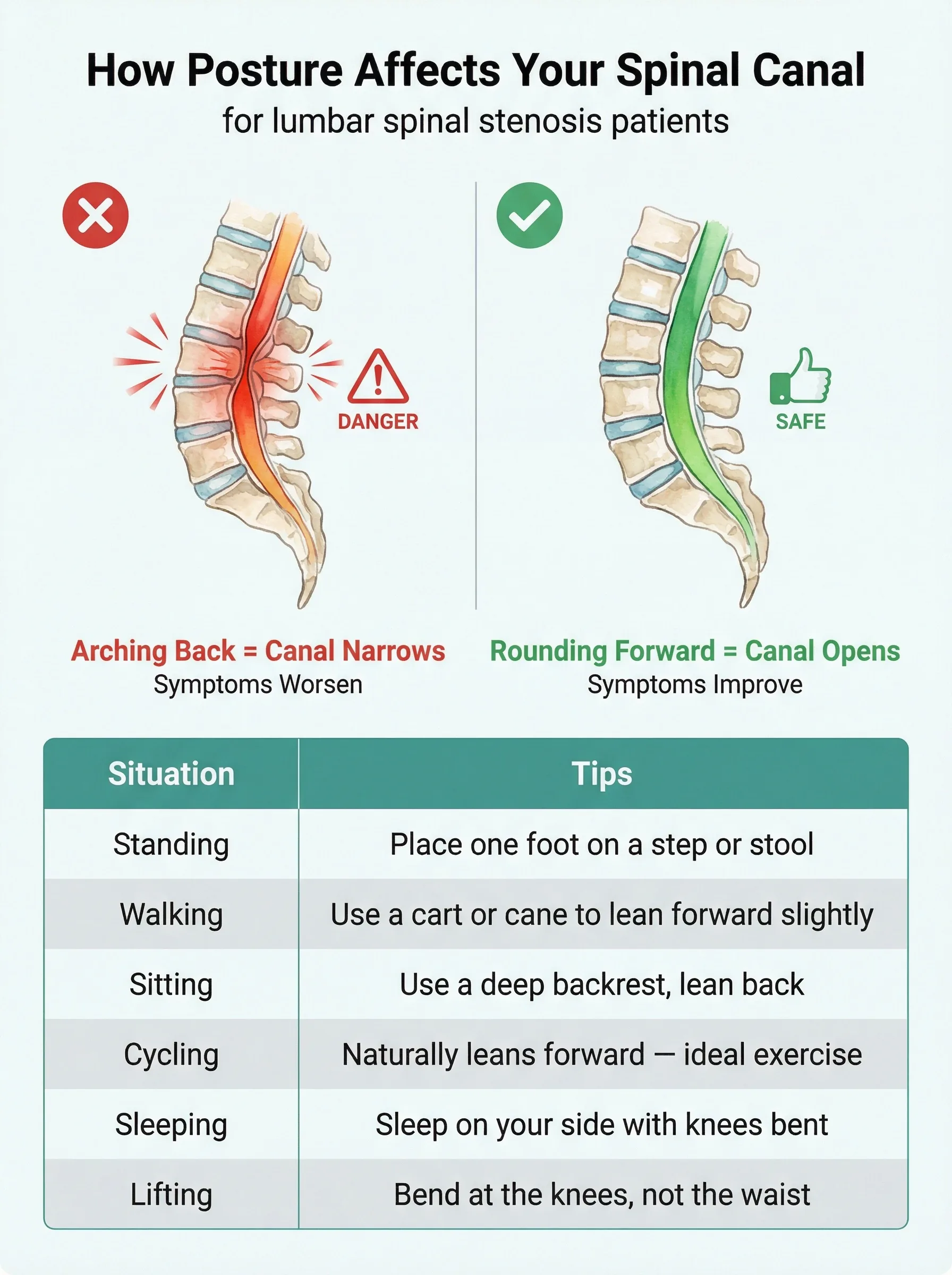
The Basic Principle
With spinal stenosis, leaning backward tends to make symptoms worse, while leaning forward tends to bring relief.
This is because leaning forward stretches the ligamentum flavum, making it thinner and widening the spinal canal. Leaning backward does the opposite: the spinal canal narrows further and the pressure on the nerves increases.
Knowing this helps you adjust your posture and movements during the day.
[!info] More detail
For a deeper explanation of why posture affects your symptoms and how intermittent claudication works, see Understanding Your Pain.
When Standing
| Tip |
What to do |
| Don't stand for long periods |
Sit down or walk around regularly |
| Rest one foot on a low step |
This reduces the arch in your lower back |
| Lean against a wall |
Takes pressure off your lower back |
| Hold on to a cart or rollator |
Encourages a forward lean; many people find it easier |
When Walking
| Tip |
What to do |
| Walk with rest breaks |
Stop and rest when pain starts; don't push through |
| Use a walking aid |
A shopping cart, rollator walker, or cane |
| Use a cane |
Supports your body and steadies your balance |
| Take downhill slopes slowly |
Use short steps; your back tends to arch, and some people find downhill harder |
When Sitting
| Tip |
What to do |
| Sit deep in the chair |
Sitting on the edge causes your back to arch |
| Use the backrest |
Reduces strain on your lower back |
| Avoid crossing your legs |
This can throw off spinal alignment |
| Avoid sitting too long |
Stand up at least once every hour |
When Lifting Objects
[!note] Proper lifting technique
❌ Bending at the waist to lift → Places enormous strain on your lower back
✅ Bend your knees, squat down, and lift with your legs → Much less strain on your lower back
| Avoid |
Do this instead |
| Lifting with your back alone |
Bend your knees and lift with your legs |
| Carrying heavy items by yourself |
Ask someone for help |
| Twisting while holding something |
Turn your whole body first, then lift |
Exercise Tips
Exercise Is Part of Your Treatment
"It hurts, so I shouldn't move" can make things worse over time. Clinical guidelines recommend exercise under professional guidance for most patients, except in severe cases.
| If you don't move... |
If you do move... |
| Muscles weaken |
Muscle strength is maintained |
| Joints stiffen |
Flexibility is preserved |
| Weight increases |
Weight is managed |
| Mood declines |
Mood improves |
Clinical studies have found that a program combining stretching, strengthening exercises, and stationary cycling is most effective. In patients with mild to moderate symptoms, some studies showed improvements comparable to surgery at the two-year mark.
Recommended Exercises
| Exercise |
Why it helps |
Notes |
| Stationary bike |
Forward-leaning position is the safest. Highest success rate in clinical studies |
An inexpensive home model works fine |
| Walking |
Fine as long as you lean slightly forward |
Take rest breaks; don't push through pain |
| Water walking |
Buoyancy reduces stress on your back |
Check that the pool temperature is comfortable |
| Stretching |
Included in 88% of successful exercise programs in studies |
Stay within a pain-free range |
Exercises to Avoid
| Exercise |
Why |
| Exercises that arch your back strongly |
Further narrows the spinal canal |
| Heavy weight training |
Places excessive strain on your lower back |
| High-impact exercises (jumping) |
Shock travels directly to the spine |
| Golf, tennis (during flare-ups) |
Involve significant twisting |
Getting Started
- "Knees-to-chest" stretch: the simplest exercise, and it brings immediate relief
- Stationary bike (if you have one): no risk of falling, and you exercise while seated
- A little every day beats a lot once a week: doing it regularly matters most
- Stop when it hurts: don't push through pain
[!tip] Detailed exercise guide
For illustrated stretching and strengthening routines, recommended frequency, comparisons with surgery outcomes, and information about rehabilitation programs, see Exercise Therapy.
2. Work, Housework, and Sleep
Managing Work and Household Tasks
If You Work at a Desk
| Adjustment |
What to do |
| Chair setup |
Sit deep with your back against the backrest |
| Monitor height |
Position it at eye level |
| Regular breaks |
Stand up at least once every hour |
| Lumbar support cushion |
Supports the natural curve of your lower back |
If You Work on Your Feet
| Adjustment |
What to do |
| Use a footrest |
Rest one foot on it to reduce the arch in your lower back |
| Use a cushioned mat |
Reduces strain on your feet and legs |
| Sit down when you can |
Take seated breaks when possible |
| Wear a lumbar brace |
Provides support during prolonged standing |
[!info] About lumbar braces
For information on brace types, usage guidelines, and what clinical guidelines say, see Conservative Treatment.
Household Task Tips
| Task |
Adjustment |
| Vacuuming |
Use an extension handle so you don't have to bend over |
| Hanging laundry |
Use a drying rack at a comfortable height |
| Cooking |
Use a counter or table at the right height for you |
| Grocery shopping |
Use a cart; buy smaller quantities more often |
| Heavy items |
Ask family for help, or use delivery services |
Sleep and Pain
The Vicious Cycle of Pain and Poor Sleep
[!note] The vicious cycle of pain and poor sleep
Pain makes it hard to sleep → Sleep deprivation → Fatigue and irritability → Pain feels more intense → Even harder to sleep...
Breaking this cycle is important. Pain is not only a physical sensation; your emotions and thought patterns play a role, too. When lack of sleep leads to fatigue and stress, they make the pain feel stronger.
[!info] About the pain cycle
For a detailed explanation of chronic pain mechanisms and the "pain vicious cycle," see Understanding Your Pain.
Tips for Better Sleep
| Tip |
What to do |
| Sleeping position |
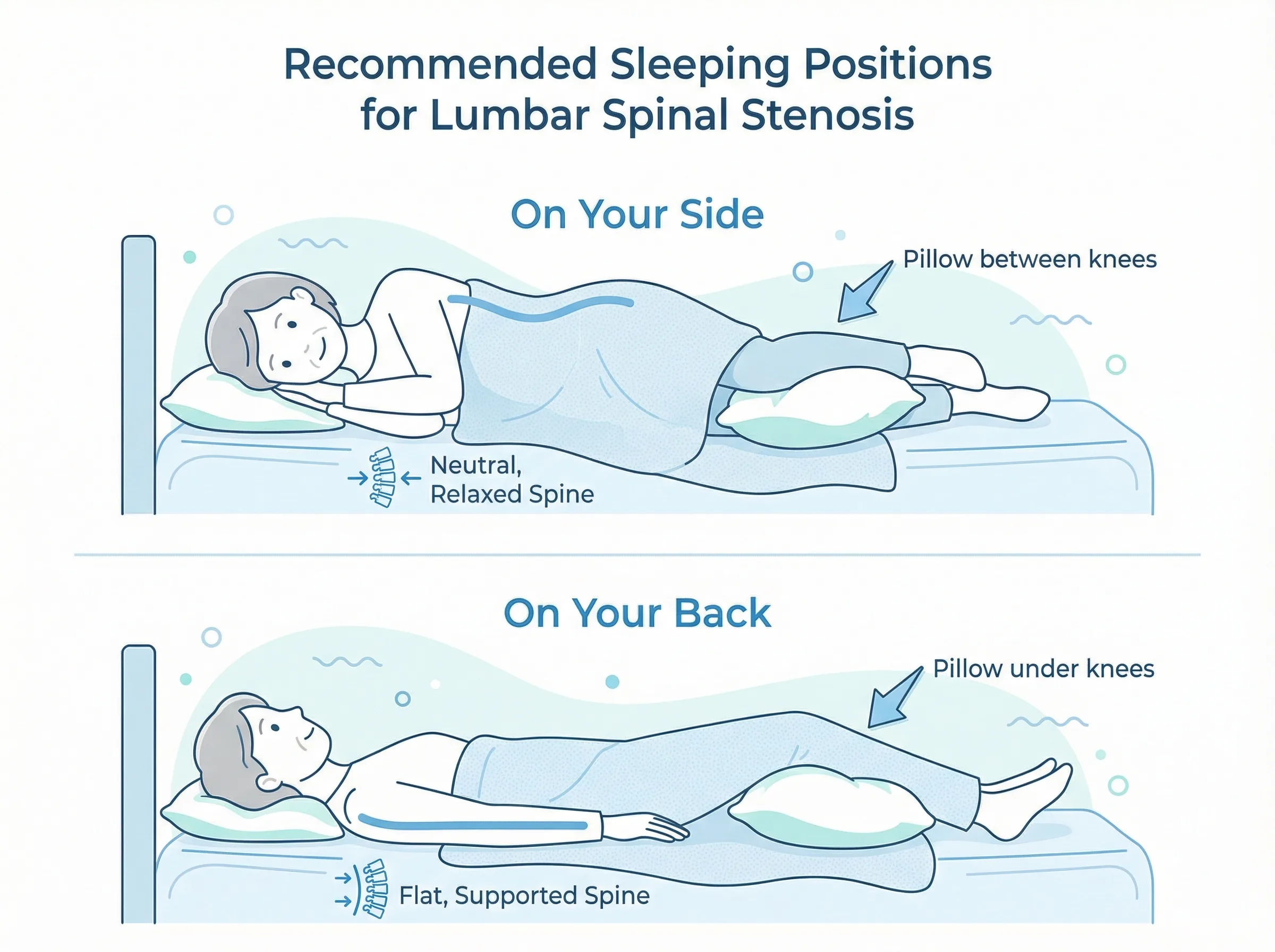
Lie on your side with knees bent, or on your back with a pillow under your knees |
| Mattress |
Not too firm, not too soft |
| Before bed |
Avoid caffeine and alcohol |
| Bedroom environment |
Keep it dark, quiet, and at a comfortable temperature |
| Pain medication |
Consider taking it before bed (discuss with your doctor) |
[!info] About pain medications
For information on types of pain medications, how to choose them, and timing tips, see Medication.
Comfortable Sleeping Positions
3. Emotional Coping and Family Support
Coping with Pain Emotionally
Chronic Pain Affects Your Mind, Too
Long-lasting pain can wear on your mental health:
- Feeling down or depressed
- Becoming easily irritated
- Feeling anxious about the future
- Losing motivation
These reactions are natural, and they are not your fault. Pain has three components (the physical sensation, emotions, and thought patterns), and each one influences the others.
[!info] Pain and the mind
For more on the three components of pain and how chronic pain changes the nervous system, see Understanding Your Pain.
Tips for Easing the Mental Burden
| Approach |
What it means |
| Accept the pain |
"Even with pain, I can still do things": this way of thinking helps a lot |
| Set small goals |
"I managed to do this today": celebrate small wins |
| Find enjoyable activities |
Hobbies you can do even with pain |
| Talk to someone |
Family, friends, or others who understand chronic pain |
| Seek professional help |
A counselor or mental health professional can help when needed |
Clinical studies show that exercise programs that incorporate psychological support have a 100% success rate, and that reducing fear and anxiety about pain leads to lasting improvements in walking ability.
Living Without Letting Pain Run Your Life
It may not be possible to reduce your pain to zero, but it is possible to reclaim your life even with pain.
Instead of "I'll do things once the pain goes away," try: "Even with pain, I'll do what I can, within my limits."
Over time, this change in thinking leads to a better quality of life.
A Message for Family Members and Caregivers
Pain Is Invisible
The pain of spinal stenosis cannot be seen from the outside.
- "Is it really that bad?"
- "Aren't you exaggerating?"
- "Maybe it's all in your head?"
These thoughts may cross your mind. But chronic pain is real, and the person living with it is the one suffering the most.
How to Support Your Loved One
| What you can do |
How |
| Listen |
Don't dismiss their pain |
| Acknowledge what they can do |
"You managed that. Well done." |
| Don't push too hard |
"Try harder" can sometimes add to the burden |
| Problem-solve together |
Find daily life adjustments as a team |
| Take care of yourself |
Your own health matters, too |
Things You Can Do Together
- Go for walks together
- Accompany them to medical appointments
- Share household tasks
- Research treatment options together
- Listen to the doctor's explanations side by side
4. Summary and Questions for Your Doctor
Summary
| Topic |
Key point |
More information |
| Posture |
Leaning forward helps; avoid arching your back |
Understanding Your Pain |
| Exercise |
A combination of stretching, strengthening, and cycling is most effective |
Exercise Therapy |
| Work and chores |
Smart adjustments let you keep going |
This page |
| Sleep |
Find a comfortable position and break the pain-sleep cycle |
This page |
| Mental health |
You can reclaim your life even with pain |
Understanding Your Pain |
| Family |
Understand the invisible pain and offer support |
This page |
Next Steps
→ Exercise Therapy: exercise routines you can fit into your daily life
→ Treatment Options: The Big Picture: wondering if your current treatment is enough, or if other options might help?
Questions to Ask Your Doctor
Here are some questions to bring up at your next appointment:
"Given my level of symptoms, how much exercise and activity is safe for me?"
- Get personalized guidance on your activity level
"Are there specific movements or positions I should avoid?"
- Understand what might make your symptoms worse
"Should I be referred for physical therapy or rehabilitation?"
- Find out if professional exercise guidance would be helpful
"What adjustments should I make to continue working?"
- Discuss workplace accommodations or whether a medical note is needed
"If pain keeps me from sleeping, can we adjust my sleep medication or pain relief?"
- Explore ways to improve sleep quality through medication adjustments
"What symptoms should make me come in right away?"
- Know the warning signs (weakness, bladder problems) that need urgent attention
"If my mood is really suffering because of the pain, should I see a mental health professional?"
- Ask about counseling or psychological support options
"How many hours a day should I wear my lumbar brace? Will long-term use weaken my muscles?"
- Understand the right balance for brace use
[!tip] More detailed question lists
For exercise-specific questions, see Exercise Therapy. For medication questions, see Medication. For conservative treatment questions, see Conservative Treatment.
Tip:
When talking to your doctor, describe your daily difficulties in specific terms. Instead of "it hurts when I walk," try something like "I get pain after walking about 200 meters to the grocery store" or "vacuuming makes my back ache." Concrete examples help your doctor give advice that fits you.
This page provides medically accurate information, but it is not a substitute for professional medical advice. Please consult your doctor for diagnosis and treatment tailored to your individual situation.