Other conditions that mimic spinal stenosis symptoms — and how doctors tell them apart.
"Herniated disc," "spondylolisthesis," "sciatica": have all these terms left you confused?
Lumbar spinal stenosis means "narrowing of the nerve pathway in the lower back." The narrowing has several possible causes: bone spurs that develop with age, bulging of the cushioning discs, thickening of the ligament behind the nerves, joint enlargement, and slight shifting of the vertebrae. Which of these changes are present, and how much they overlap, differs from person to person. Two people can both be told they have "lumbar spinal stenosis" and still have quite different changes inside their spines.
What You'll Learn
How spinal stenosis differs from a herniated disc
What degenerative spondylolisthesis is
Why "sciatica" is not a diagnosis
How to tell the difference from vascular problems
Why you may receive multiple diagnoses
1. Herniated Disc and Spondylolisthesis
How Spinal Stenosis Differs from a Herniated Disc
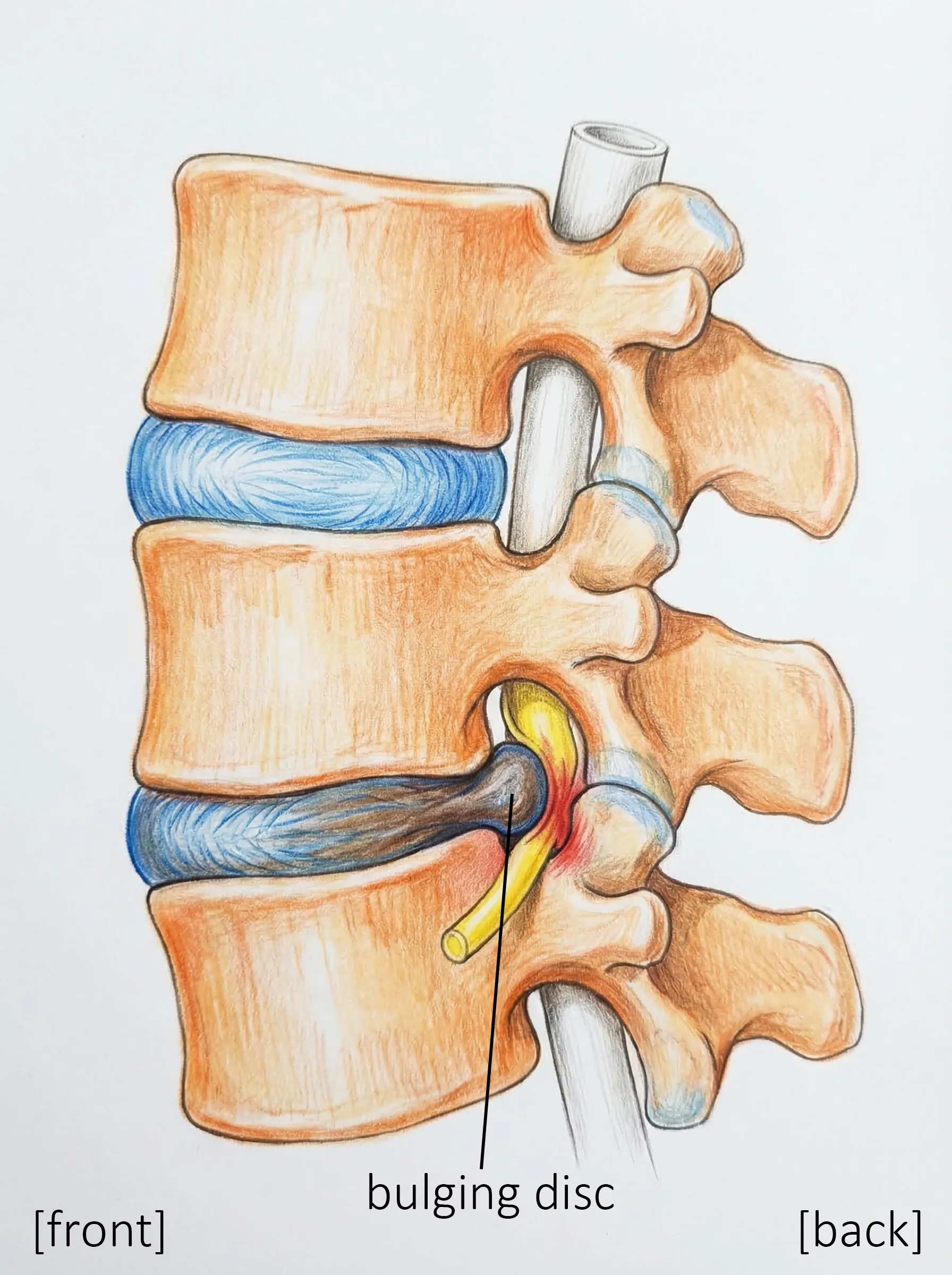
What Is a Herniated Disc?
A herniated disc occurs when the soft center of a disc (the nucleus pulposus) pushes out and presses on a nerve.
Key Differences from Spinal Stenosis
Feature
Herniated Disc
Lumbar Spinal Stenosis
Typical age
More common in your 20s-50s
More common after age 50
How it starts
Often sudden onset
Symptoms develop gradually
Main cause
The disc pushes outward
The entire spinal canal narrows
Painful posture
Worse when bending forward
Worse when leaning back; better when bending forward
Intermittent claudication
Uncommon
A hallmark symptom
Natural course
Often improves on its own
Tends to progress over time
A Simple Way to Tell Them Apart
Bending forward brings relief -> More likely spinal stenosisBending forward makes it worse -> More likely a herniated disc
But both conditions can exist at the same time.
In older adults especially, a disc herniation from earlier years may be present alongside age-related stenosis. In such cases, doctors typically use the broader diagnosis of lumbar spinal stenosis and describe the disc as "bulging" rather than calling it a separate herniation.
Degenerative Spondylolisthesis
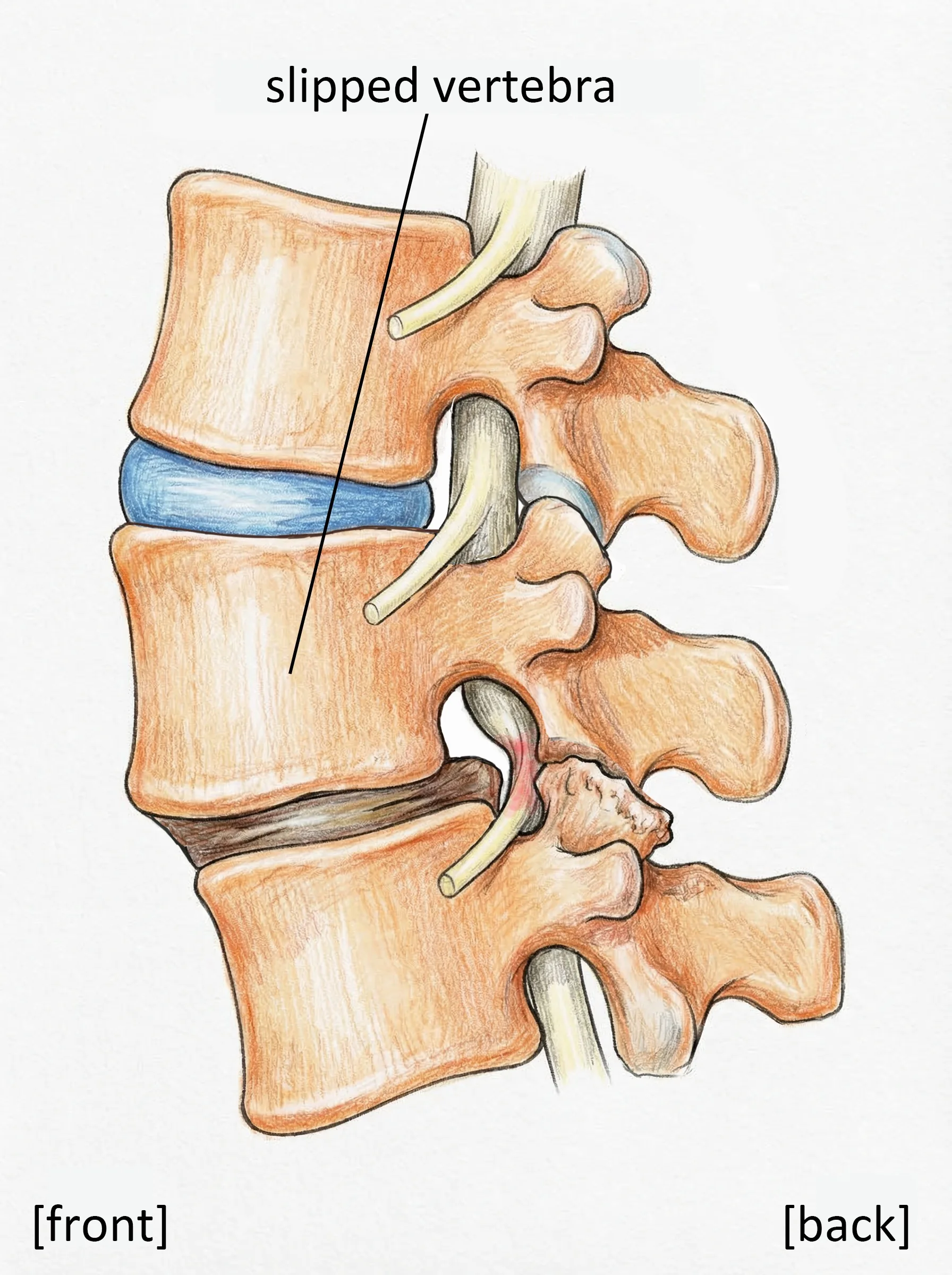
What Is Spondylolisthesis?
Spondylolisthesis means that one vertebra has slipped forward or backward relative to the one below it.
How It Relates to Spinal Stenosis
When a vertebra slips, the spinal canal is more likely to become narrow. If one building block in a stack shifts out of place, the tunnel running through the middle shifts too, and the nerves inside get squeezed.
So spondylolisthesis and spinal stenosis are often related.
Diagnosis
What It Means
Lumbar spinal stenosis
The spinal canal is narrow
Degenerative spondylolisthesis
A vertebra has slipped out of place
Stenosis with degenerative spondylolisthesis
Both are present
If your doctor tells you that "you also have spondylolisthesis," the slip may be one of the reasons your spinal canal has become narrow.
How It Affects Treatment
The degree and instability of the slip can influence the treatment plan. Instability is assessed by taking X-rays while you bend forward and lean backward, then measuring how much the slip changes with movement. If the vertebra shifts well forward when you bend, the instability is high.
Mild slip -> Decompression surgery alone may be sufficient
Unstable slip -> A fusion procedure (surgically stabilizing the spine) may be necessary
When instability is high, decompression alone (removing bone and ligament to make more room) may not be enough, because the vertebra can slip further and narrow the canal again. That is why fusion is often recommended in these cases.
2. Sciatica and Vascular Claudication
"Sciatica" Is Not a Diagnosis
A Common Misunderstanding
Many people are told they have "sciatica" and assume it is a specific disease.
But sciatica is the name of a symptom, not a disease. A "headache" is also a symptom, and the condition behind it could be anything from a brain hemorrhage to a tension headache.
[!note] The sciatic nerve pathway
The sciatic nerve is typically formed from nerve roots L4 through S3.
Lumbar spine → Nerve roots → Sciatic nerve → Buttock → Back of thigh
When the nerve roots are compressed, pain travels along the sciatic nerve = sciatica
Conditions That Cause Sciatica
Several conditions can cause sciatica:
Lumbar spinal stenosis: the most common cause in older adults
Herniated disc: the most common cause in younger people
Degenerative spondylolisthesis
Piriformis syndrome (the sciatic nerve is compressed by a muscle deep in the buttock)
Other conditions
"Sciatica" describes the symptom. What matters is finding the underlying cause (the actual diagnosis).
Telling the Difference from Vascular Claudication
Similar Symptoms
Conditions that block blood flow to the legs (such as peripheral artery disease) can also cause leg pain while walking that improves with rest.
This is called vascular claudication.
How to Tell Them Apart
Feature
Neurogenic (Spinal Stenosis)
Vascular
How you rest
Relief comes from leaning forward
Relief comes from simply standing still
Bicycling
Usually no problem
Can still cause pain
Time to relief
Hard to relieve without bending forward or sitting
Standing still usually relieves it within about 10 minutes
Cold feet
Not typically related
Feet are often cold
Foot pulses
Normal
Weak or absent
Both Can Coexist
In older adults, spinal stenosis and vascular problems can exist together. In a Japanese study, about 1 in 15 people with spinal stenosis also had artery disease in the legs.
If a vascular problem is suspected, initial tests such as an ABI (ankle-brachial index) or CAVI (cardio-ankle vascular index) may be performed in the clinic. The ABI checks whether blood flow to your legs is reduced. The CAVI measures how stiff your blood vessels have become, a kind of "vascular age." For both tests, blood pressure cuffs are wrapped around your arms and legs while you sit still for a few minutes. They are no more uncomfortable than a regular blood pressure check.
If these tests suggest a vascular issue, a referral to a vascular specialist or cardiologist may be recommended.
3. Multiple Diagnoses, Summary, and Questions
Why You May Receive Multiple Diagnoses
"I've been told so many different things -- it's confusing"
When you see a doctor, you may hear several different diagnosis names.
For example:
"Lumbar spinal stenosis"
"Degenerative spondylolisthesis"
"Disc degeneration"
"Sciatica"
This is not a mistake. Multiple problems often overlap.
Why They Overlap
The changes in your spine with aging rarely involve just one structure.
[!note] How age-related changes accumulate
20s: Normal → 40s: Disc degeneration begins → 50s: Bone spurs start forming, ligaments thicken → 60s: Stenosis progresses, slipping may develop → Multiple problems layered together
What Matters Most
Even when multiple problems are present, your treatment plan depends on one question: What is the main cause of your current symptoms?
Summary
Key Point
Details
Herniated disc vs. stenosis
A herniation means the disc pushes out; stenosis means the canal narrows overall
Spondylolisthesis
A slipped vertebra often contributes to stenosis; the two are frequently related
Sciatica
A symptom, not a diagnosis
Vascular claudication
Similar symptoms but a different cause, so the two need to be told apart
Multiple diagnoses
Having overlapping conditions is common, not unusual
Next Steps
Tests and Diagnosis: the tests used to confirm the diagnosis and distinguish between conditions
Consider asking these questions at your next appointment:
"Based on my symptoms, do you think the main cause is stenosis, a herniated disc, or spondylolisthesis?"
When you have several diagnoses, this clarifies which one is the primary issue
"I have several diagnoses -- which one is the main cause of my current symptoms?"
This links your MRI findings to your symptoms
"Of the changes seen on my MRI, which ones are related to my symptoms?"
This tells you what each imaging finding means for you
"Could a vascular problem be contributing? Should I see a vascular specialist?"
This helps rule out vascular claudication
"If I have spondylolisthesis, how likely is it that I would need a fusion surgery?"
This lets you think about your treatment options in advance
"Is my pattern of feeling better when leaning forward consistent with spinal stenosis?"
This confirms that your symptoms and diagnosis match
Tip:
Bring the comparison tables from this page (herniation vs. stenosis, neurogenic vs. vascular) to your appointment and ask, "Which pattern best matches my case?" You will usually get a more specific explanation.
This page provides medically accurate information, but it is not a substitute for professional medical advice. Please consult your doctor for diagnosis and treatment tailored to your individual situation.